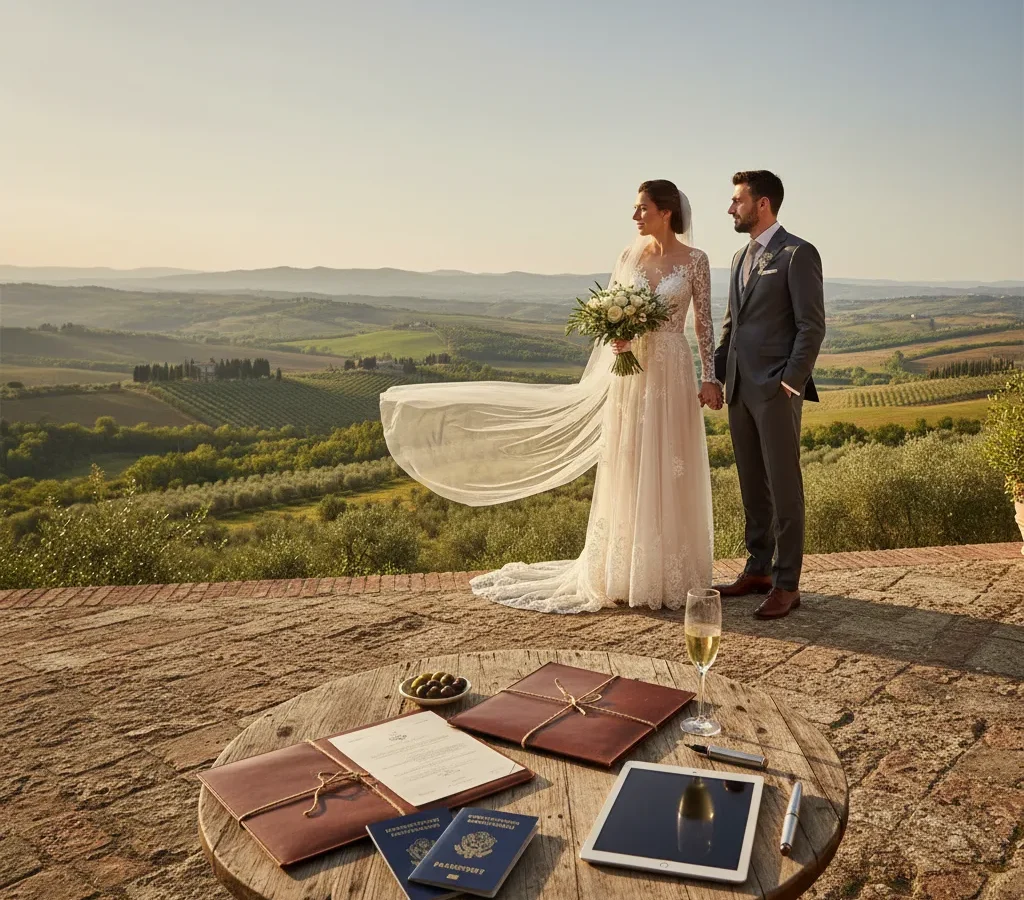
If you are in the early stages of planning your celebration, understanding destination wedding Italy legal requirements will shape every other decision you make, from timing and travel to venue choice and photography. The following guide walks you through the essentials so you can move forward with clarity and confidence.
Introduction
Planning a destination wedding in Italy is one of the most romantic decisions a couple can make. From the sunlit hills of Tuscany to the shimmering waters of Lake Como, Italy offers backdrops that no studio could ever replicate. Yet behind the beauty lies a layer of administrative reality that many couples underestimate. Understanding the destination wedding Italy legal requirements before you book your villa or your photographer will save you significant stress and allow you to focus on what truly matters: celebrating with the people you love most.
A Simple Guide to Destination Wedding Italy Legal Requirements for Americans Marrying in Italy
Temps de lecture : ~10 min
- Can You Legally Get Married in Italy as a Foreign National?
- Types of Ceremonies and Their Legal Status
- General Legal Requirements for Getting Married in Italy
- The Step-by-Step Legal Process for American Citizens
- What Happens at the Town Hall
- Legal Ceremony vs Symbolic Ceremony
- A Practical Planning Timeline
- FAQ
- Why Early Planning Matters for Americans Marrying in Italy

Can You Legally Get Married in Italy as a Foreign National?
The short answer is yes. Foreign nationals, including American citizens, can have a fully legal civil wedding in Italy that is recognized internationally. There is no official residency requirement, which means you do not need to establish a temporary address in Italy to qualify. That said, you will generally need to arrive a few days before the ceremony to attend appointments at the town hall and, in some cases, at a US consulate located in Italy.
Once the civil ceremony is complete, you receive a bilingual marriage certificate that is legally binding both in Italy and in your home country. The process is entirely accessible to Americans, but it does require careful advance planning and a clear understanding of which documents to prepare and when.
Types of Ceremonies and Their Legal Status
Not all weddings in Italy carry the same legal weight, and this distinction matters enormously for planning purposes.
Civil and religious ceremony options
A civil ceremony conducted by the mayor or a delegated official at the town hall is the most popular choice for foreign couples and is fully legally binding. A Roman Catholic ceremony can also be legally recognized, provided at least one partner is Catholic and neither has been previously divorced without a church annulment. Non-Catholic religious ceremonies, humanist ceremonies, and symbolic blessings, however, are not legally recognized on their own under Italian law.
This is why many American couples choose to handle the legal formalities at a registry office in their home state before traveling to Italy, then celebrate with a symbolic ceremony at their dream venue. This approach is entirely valid and increasingly common. It removes the constraint of town hall opening hours and government-approved officiant requirements, giving couples and their photographers far greater creative freedom over timing, location, and atmosphere.
Same-sex couples and civil unions
Same-sex couples should note that Italy does not currently permit same-sex marriage, but it does offer legally recognized civil unions that can be celebrated with a formal ceremony.
General Legal Requirements for Getting Married in Italy
Whether you are planning a fully legal Italian civil wedding or gathering documents to support a symbolic ceremony, there is a core set of materials that virtually every foreign couple will need to prepare.
Core documents required for destination wedding Italy legal requirements
- Valid passports for both partners
- Long-form birth certificates showing both parents’ full names
- Evidence of the termination of any previous marriage, such as a final divorce decree, annulment, or death certificate
- Parental or guardian consent if either partner is under 18
- Certified Italian translations of all documents issued outside Italy
- An Apostille stamp on each document, obtained from the relevant government authority in your home country
Under Italian law, documents originating outside the European Union are typically valid for only six months from their date of issue. Timing your document preparation accordingly is essential.

The Step-by-Step Legal Process for American Citizens
For US couples pursuing a fully legal ceremony in Italy, the process involves several distinct stages, each with its own timeline.
Step 1: Obtain the Atto Notorio
This is a sworn declaration confirming that no legal obstacle exists to your marriage under US law. It can be obtained at an Italian embassy or consulate in the United States, or at an Italian court with two witnesses present. Those witnesses must be over 18, not family members, and must present a valid form of identification. Critically, you must obtain the Atto Notorio within three months of your wedding date. Obtaining it earlier risks expiration before your ceremony takes place.
Step 2: Obtain the Dichiarazione Giurata, also known as the Nulla Osta
This is a sworn statement made before a US consular officer in Italy confirming that no legal impediment to the marriage exists under US law. Appointments are available at the US Embassy in Rome and at US consulates in cities including Milan, Florence, Naples, Venice, and Palermo. This document costs approximately 50 USD per person and is valid for six months. It is generally advisable to schedule this appointment around one month before your wedding date, though availability varies by consulate.
Step 3: Legalization at the Prefettura
Once you have your Dichiarazione Giurata, you must bring it to the local Prefettura, which is the regional legalization office, for authentication. You will need to purchase one or two revenue stamps (marca da bollo) worth 16 euros each, available at any tobacco shop (tabaccheria), and present them to the clerk at the Prefettura.
Step 4: Apostille and certified translation
All US documents, including birth certificates and divorce decrees, must be apostilled by the Secretary of State in the state where the document was issued. They must then be translated into Italian by a certified translator.
Step 5: Register at the Ufficio Matrimoni
With all documents in order, you present them to the Marriage Office at the town hall in your wedding city. There, you will sign a Declaration of Intention to Marry before a civil registrar. If you do not speak Italian, you will need to bring a certified interpreter.
One additional note for female applicants: if a previous marriage ended within 300 days of the planned Italian wedding, a waiver from the Italian District Attorney’s Office confirming the absence of pregnancy may be required.
What Happens at the Town Hall
The town hall, or municipio, is the administrative heart of any legal Italian wedding. After submitting your documents to the Ufficio Matrimoni, Italian law generally requires civil banns (pubblicazioni di matrimonio) to be posted publicly for two consecutive weeks, including two Sundays, before the ceremony can take place. Some municipalities handle this requirement differently for foreign couples, so it is worth confirming local practice with your wedding planner or a local contact.
The cost of renting a town hall ceremony space varies considerably, ranging from around 100 euros to 2,000 euros depending on the location, with an average of approximately 500 euros. Total paperwork costs across your home country and Italy typically amount to around 600 euros for a foreign couple.
Legal Ceremony vs Symbolic Ceremony
| Legal civil ceremony in Italy | Symbolic ceremony in Italy | |
|---|---|---|
| Legally binding | Yes | No (legal part done at home) |
| Venue flexibility | Limited to licensed venues | Villas, cliffs, vineyards, private estates |
| Officiant | Government-approved only | Independent celebrant, friend, or family member |
| Ceremony timing | Subject to town hall hours | Fully flexible, including sunrise or sunset |
| Document complexity | High | Minimal once legally married at home |
| Photography freedom | Moderate | Maximum creative latitude |
For couples who have invested in a once-in-a-lifetime venue, a symbolic ceremony often makes more practical and aesthetic sense. It allows the wedding day to be shaped entirely around the experience rather than administrative constraints. Legal paperwork completed weeks before departure means that by the time the couple arrives in Italy, the focus can shift entirely to celebration, connection, and imagery.

A Practical Planning Timeline
Getting the paperwork right requires starting earlier than most couples expect. Here is a general framework to work from, keeping both the legal process and your photography planning in mind.
Key milestones in your Italian wedding paperwork timeline
Twelve to eighteen months before the wedding, secure your venue and begin working with your wedding planner to identify which type of ceremony you want. If you plan a fully legal Italian civil wedding, your planner should connect you with a local specialist familiar with the Ufficio Matrimoni in your specific city.
Six to nine months out, begin gathering core documents: long-form birth certificates, divorce decrees if applicable, and passports. Start the Apostille process through your state’s Secretary of State office and engage a certified Italian translator.
Three months before the wedding, obtain your Atto Notorio. Do not obtain it earlier, as it risks expiring before your ceremony date.
One to two months before departure, schedule your Nulla Osta appointment at the nearest US consulate in Italy. Note that consulate availability can be limited, so booking early is advisable.
Upon arrival in Italy, allow at least two to three days before the wedding for consulate visits, the Prefettura legalization step, and the town hall appointment. These administrative half-days should be factored into your pre-wedding photography schedule, particularly if you have planned an engagement session or venue walkthrough during that period.
FAQ
Do I need to speak Italian to get married in Italy?
No. If you do not speak Italian, you are required to bring a certified interpreter to your town hall appointment. Many wedding planners who specialize in destination weddings for American couples have trusted interpreters they work with regularly, which simplifies this step considerably.
Can a friend or family member officiate our wedding in Italy?
For a legally binding ceremony, no. Italian civil law requires the ceremony to be conducted by the mayor or a delegated government official. However, if you choose a symbolic ceremony, having a close friend or independent celebrant officiate is entirely possible and is in fact one of the main reasons many couples opt for this format.
How far in advance should we start the paperwork?
For a fully legal Italian civil wedding, starting the process at least twelve months in advance is strongly recommended. The Apostille process, certified translations, and consulate appointment availability all take more time than most couples anticipate. For a symbolic ceremony where the legal marriage takes place in the United States, the administrative burden is significantly lighter, though you should still confirm requirements with your local registrar well in advance.
What is the difference between the Atto Notorio and the Nulla Osta?
Both documents serve a similar purpose: they confirm that no legal impediment to the marriage exists under US law. The Atto Notorio is typically obtained at an Italian consulate in the United States before departure, while the Nulla Osta (formally called the Dichiarazione Giurata) is a sworn statement made before a US consular officer in Italy. Your wedding planner or a local legal specialist can advise on exactly which combination of documents your specific municipality requires.
Why Early Planning Matters for Americans Marrying in Italy
Navigating the legal side of a destination wedding in Italy is genuinely complex, but it is entirely manageable with the right team around you. Whether you choose to marry fully under Italian law or complete the legal formalities at home and celebrate with a symbolic ceremony, understanding the process early gives you the freedom to make intentional decisions rather than reactive ones. The couples who arrive in Italy with their paperwork resolved and their timeline thoughtfully planned are the ones who are fully present on their wedding day, and that presence is exactly what transforms beautiful photographs into lasting heirlooms.
If you are beginning to plan your Italian wedding and want to understand how photography integrates with your overall timeline, Lino Ludovic offers the kind of culturally attuned, editorially driven coverage that honors every detail of your celebration.