Introduction to a winter elopement in the French Alps
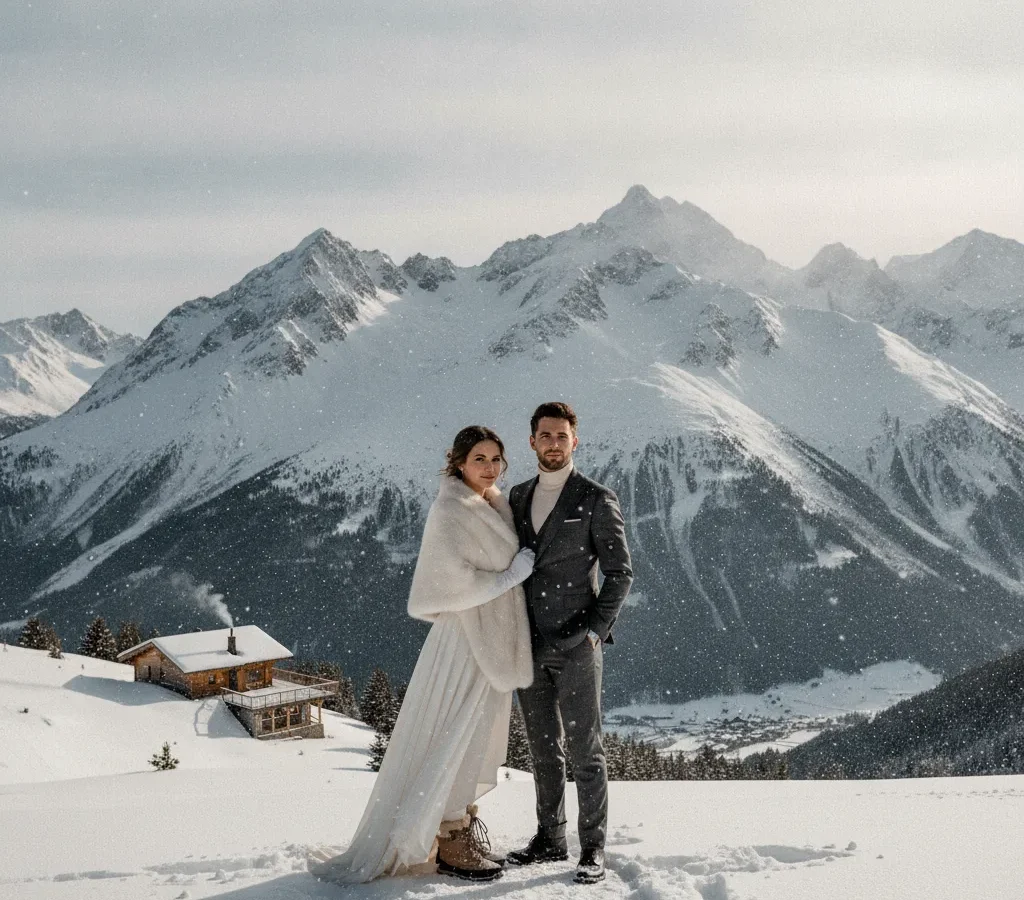
There is something undeniably magnetic about exchanging vows in the middle of a snow-covered Alpine landscape, surrounded by silence, peaks, and the kind of light that only exists in winter. A winter elopement in the French Alps is not simply a trend — it is a deeply intentional choice made by couples who want their wedding day to feel like the beginning of a great adventure. Whether you are dreaming of the glamour of Megève, the ski-in elegance of Courchevel, or the raw drama of the Mont Blanc massif, the French Alps offer a setting that is both cinematic and profoundly intimate. This guide is written for couples planning from the United States who want to elope in France with elegance, intention, and a photographer who truly understands this world.
A Cozy & Chic Winter Elopement in the French Alps (Megève, Courchevel)
Temps de lecture : ~7 min
Table of contents
- Why a Winter Elopement in the French Alps Is in a Category of Its Own
- The Best Time of Year for a Snowy French Alps Elopement
- Megève, Courchevel, and Beyond — Choosing Your Setting
- How to Elope in France as an American Couple
- What to Wear for a Winter Elopement in the Mountains
- Why Your Photographer Makes or Breaks a Winter Elopement
- Designing Your Elopement Day in the Alps
- Why A Winter Elopement in the French Alps Rewards Intention
Why a Winter Elopement in the French Alps Is in a Category of Its Own
Most destination weddings take place in summer. The lavender fields of Provence, the terraces of the Amalfi Coast, the golden light of a Tuscan vineyard at dusk — these are the images that dominate the wedding industry. And yet, for a certain type of couple, that is precisely the problem. They are not looking for the expected. They want something that feels entirely their own.
A snowy mountain elopement in France delivers exactly that. The French Alps in winter are dramatic without being theatrical, luxurious without being loud. Resorts like Megève and Courchevel have long attracted a European elite that values discretion and refinement over spectacle. The architecture is warm, the chalets are impeccable, and the landscape changes hour by hour as the light moves across the snow. From a purely photographic standpoint, it is one of the most rewarding environments in the world to work in.
Beyond aesthetics, there is an emotional dimension to a winter elopement that is difficult to replicate in any other season. The cold draws people together. A shared thermos of vin chaud after the ceremony, the breath visible in the mountain air, the contrast between the warmth of a chalet fireplace and the blue-white world outside — these are the details that make images feel alive decades later.
The Best Time of Year for a Snowy French Alps Elopement
Key winter months for a French Alps elopement
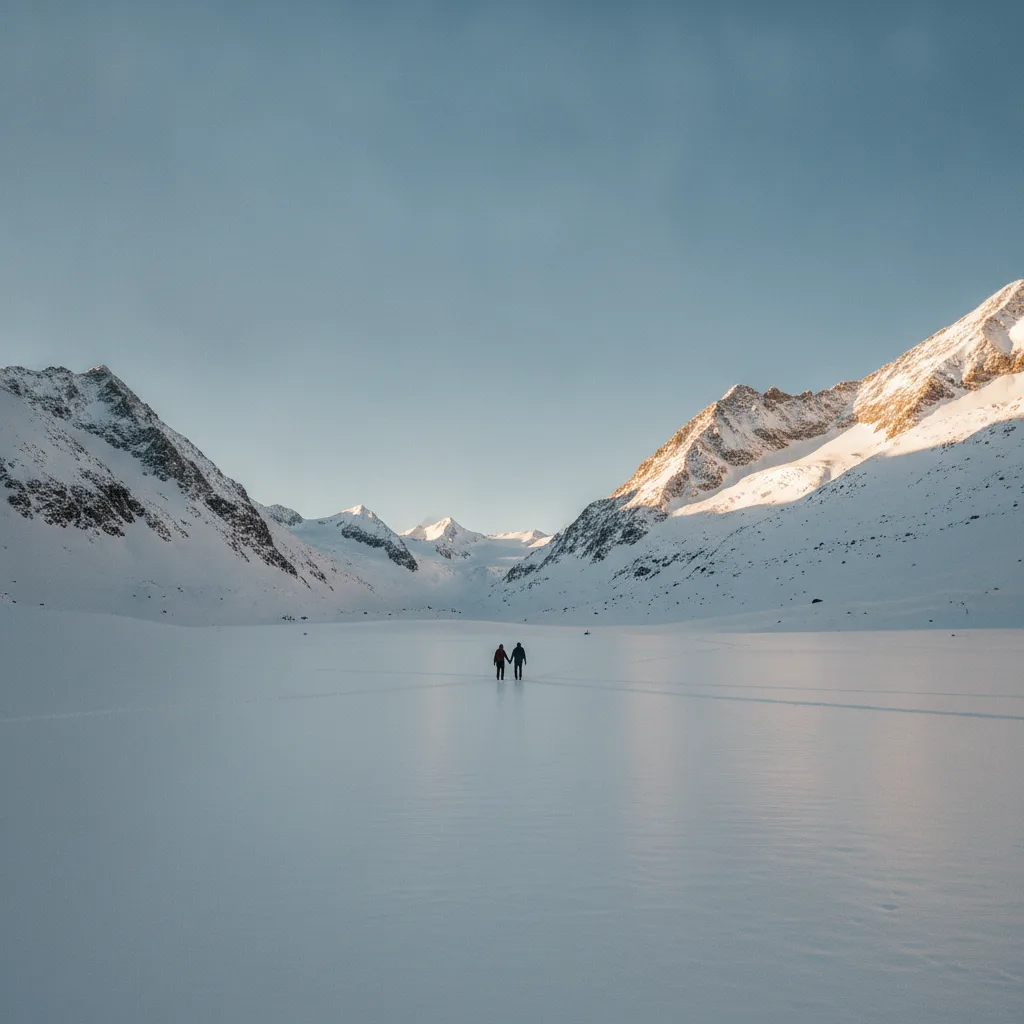
Timing matters enormously when planning a winter mountain elopement, and getting it right is the difference between a magical experience and a logistical headache. The most reliable window for snow in the French Alps runs from late December through late March. Within that range, January, early February, and March tend to offer the best combination of snow coverage, stable weather, and manageable crowds.
The Christmas and New Year period, while visually stunning, brings peak resort traffic to Megève and Courchevel. Prices rise sharply, availability narrows, and the intimate atmosphere you are seeking can feel harder to achieve. Early February, after the initial holiday rush, is often ideal. The snowpack is deep, the light is extraordinary (low on the horizon, casting long golden shadows across the snow), and the resorts have a quieter, more exclusive energy. March adds the bonus of longer days and slightly warmer temperatures, which makes outdoor portrait sessions more comfortable without sacrificing the snow.
| Period | Snow & light | Atmosphere |
|---|---|---|
| Late December – late March | Most reliable overall window for snow in the French Alps | Classic winter mountain conditions across the season |
| Christmas & New Year | Visually stunning with festive lights and deep winter snow | Peak resort traffic, higher prices, and a less intimate feel |
| January & early February | Deep snowpack and extraordinary low winter light | Quieter, more exclusive energy after the holiday rush |
| March | Reliable snow with longer days and slightly warmer temperatures | More comfortable outdoor sessions with a relaxed late-winter mood |
One practical note that cannot be overstated: always build a backup date into your planning. Winter in the Alps is beautiful precisely because it is unpredictable. A storm can move in overnight and transform a clear summit into a whiteout. A professional photographer who knows this terrain will help you identify a secondary location and, if necessary, a secondary date — so that no matter what the weather does, your elopement day is protected.
Megève, Courchevel, and Beyond — Choosing Your Setting
The French Alps contain multitudes. Choosing the right location for your elopement depends on the atmosphere you want to create and the kind of images you want to live with forever.
Megève
Megève is perhaps the most photogenic village in the French Alps. Its medieval church, cobblestone streets, and Belle Époque architecture give it a warmth and character that purpose-built ski resorts simply cannot replicate. Megève feels like a film set that also happens to be a real place. The light in the village at dusk, with the surrounding peaks catching the last of the sun, is extraordinary. For couples who want a chic, intimate atmosphere with a distinctly French character, Megève is unmatched.
Courchevel
Courchevel operates on a different register entirely. As one of the most prestigious ski resorts in the world, it offers an almost theatrical level of luxury — private chalets, Michelin-starred restaurants, helicopter access to high-altitude viewpoints. A Courchevel elopement can be built around the mountain itself: a cable car to a summit ceremony, portraits on a groomed piste at golden hour, dinner by a fireplace with the valley spread below. It suits couples who want grandeur and are comfortable in that environment.
Chamonix and Mont Blanc
Further afield, the Chamonix and Mont Blanc region offers something more raw and adventurous. The scale of the landscape here is humbling — the Aiguille du Midi, the Mer de Glace, the sheer verticality of the massif. For couples who want their elopement to feel like a genuine Alpine expedition, Chamonix delivers an energy that is impossible to find elsewhere in France.
How to Elope in France as an American Couple
Legal vs symbolic ceremonies in France
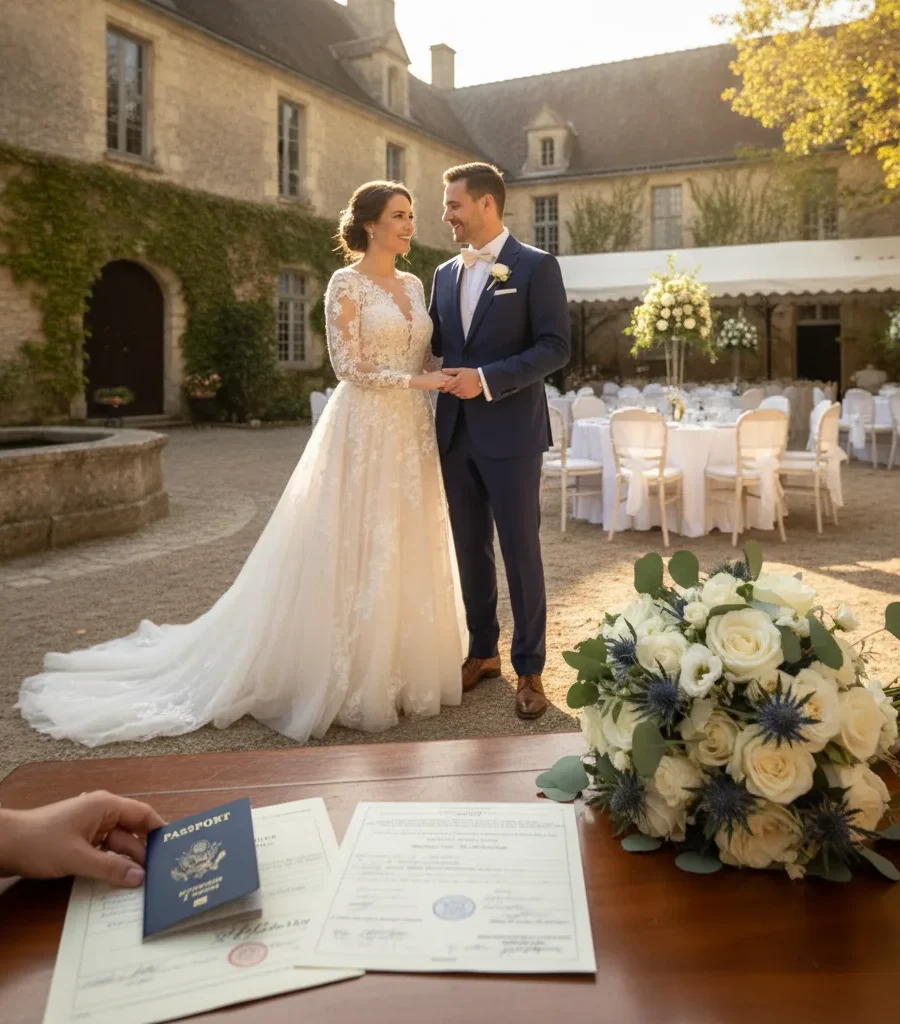
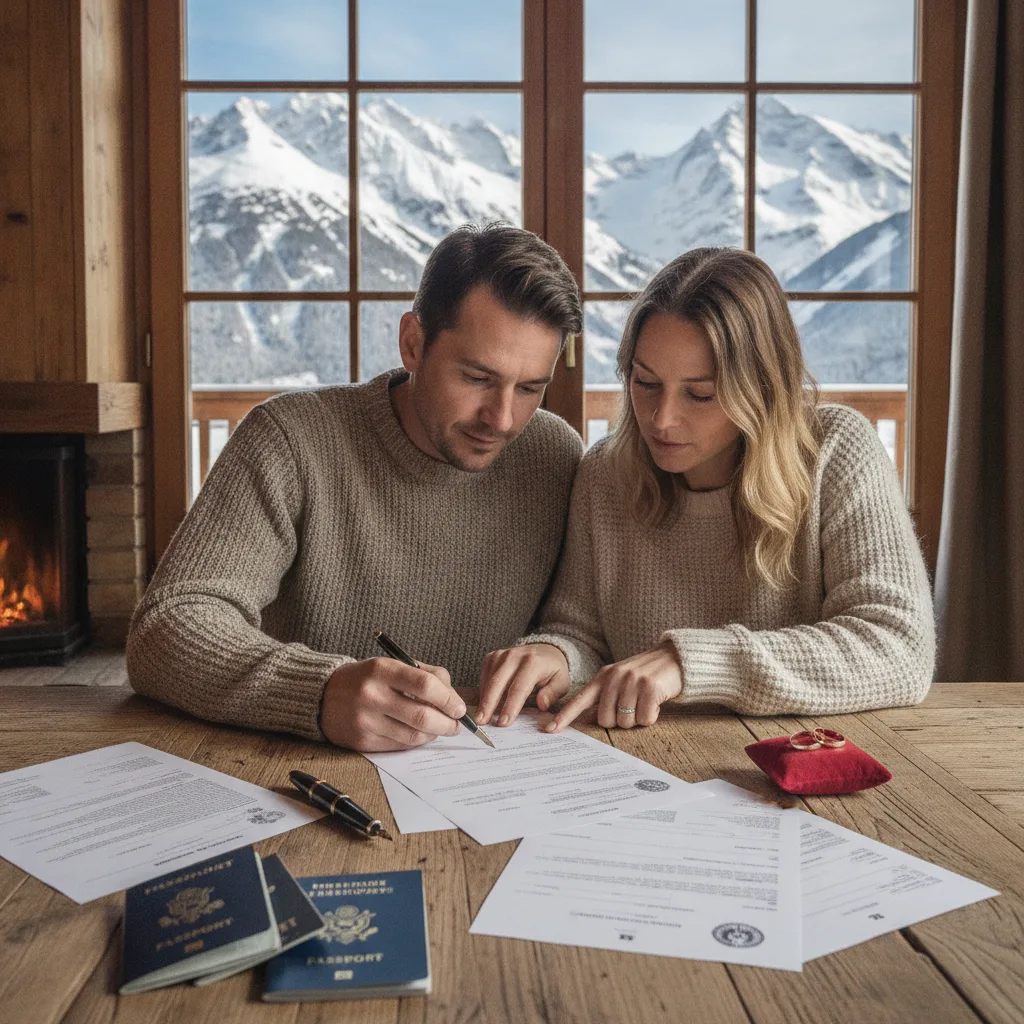
This is the question that causes the most anxiety among US couples planning a French Alps elopement, and the answer is simpler than most people expect. French civil law requires that at least one partner have a formal administrative connection to France (residency, for example) in order to conduct a legally binding ceremony on French soil. For most American couples, this means that the most practical approach is to complete the legal marriage at home — at a courthouse in California, New York, or wherever you are based — and then travel to France for a symbolic ceremony that carries all the emotional weight of a wedding without the administrative complexity.
A symbolic ceremony officiated by a bilingual celebrant in the French Alps is, in every meaningful sense, your real wedding. You write your own vows, you choose your own rituals, and you do it in one of the most beautiful places on earth. Many couples find that removing the legal formalities from the equation actually makes the ceremony more personal and more present.
If you are committed to a fully legal French ceremony, it is possible, but it requires planning well in advance, a period of residency or administrative preparation, and a local notary or officiant who specializes in international marriages. Your photographer and planner can connect you with the right professionals.
What to Wear for a Winter Elopement in the Mountains
Layering strategy for a winter mountain wedding
This is a question that deserves serious attention, because comfort and elegance are not mutually exclusive in the Alps — but they do require planning. The couples who feel most at ease during their winter elopement are the ones who thought carefully about layering.
The principle is straightforward: start with a thermal base layer (merino wool is ideal, as it regulates temperature and wicks moisture), add your wedding attire as the middle layer, and keep a high-quality down jacket accessible for the moments between portraits. For brides, fleece-lined leggings worn under a gown are invisible in photographs and make an enormous difference in comfort. For suits, ensure there is enough room under the jacket for a thin thermal layer beneath the shirt.
A few additional details that matter more than you might expect:
- Wool socks and waterproof boots for any outdoor movement on snow or ice
- Hand warmers (reusable or single-use) kept in a coat pocket for the moments between shots
- A thermos of something warm — coffee, tea, or a proper vin chaud — to sip between locations
- Microspikes or grip attachments for walking on packed snow, particularly at high altitude
From a styling standpoint, the French Alps reward simplicity. Clean lines, rich textures, and a palette that works with the landscape rather than against it. A cream or ivory gown against fresh snow, a charcoal wool suit, a fur stole or a cashmere wrap — these choices photograph beautifully and feel genuinely luxurious rather than costumey.
Why Your Photographer Makes or Breaks a Winter Elopement
A winter mountain elopement in the French Alps is not a forgiving environment for an inexperienced photographer. Snow creates extreme exposure challenges. The light changes rapidly, moving from the warm gold of sunrise to the flat white of midday to the extraordinary pink and violet of Alpine dusk in the space of a few hours. A photographer who does not know how to manage these conditions will return home with technically compromised images that fail to capture what was actually there.
Beyond the technical dimension, there is a question of physical preparedness. Moving through deep snow with camera equipment, scouting locations in advance, knowing which cable car to take and when the light will hit a particular face of the mountain — this is knowledge that only comes from genuine experience in the Alps. It is also knowledge that directly serves you, because it means your photographer arrives on the day with a plan, a backup plan, and the confidence to adapt when conditions change.
The most important quality, however, is discretion. A winter elopement is an intimate experience. You have chosen to celebrate with the people who matter most, in a place that requires real effort to reach. The last thing you want is a photographer who directs every moment, imposes poses, or makes the day feel like a production. The approach that serves couples best is one of quiet observation combined with artistic direction — someone who knows how to make you look extraordinary while you are simply living the day.
Designing Your Elopement Day in the Alps
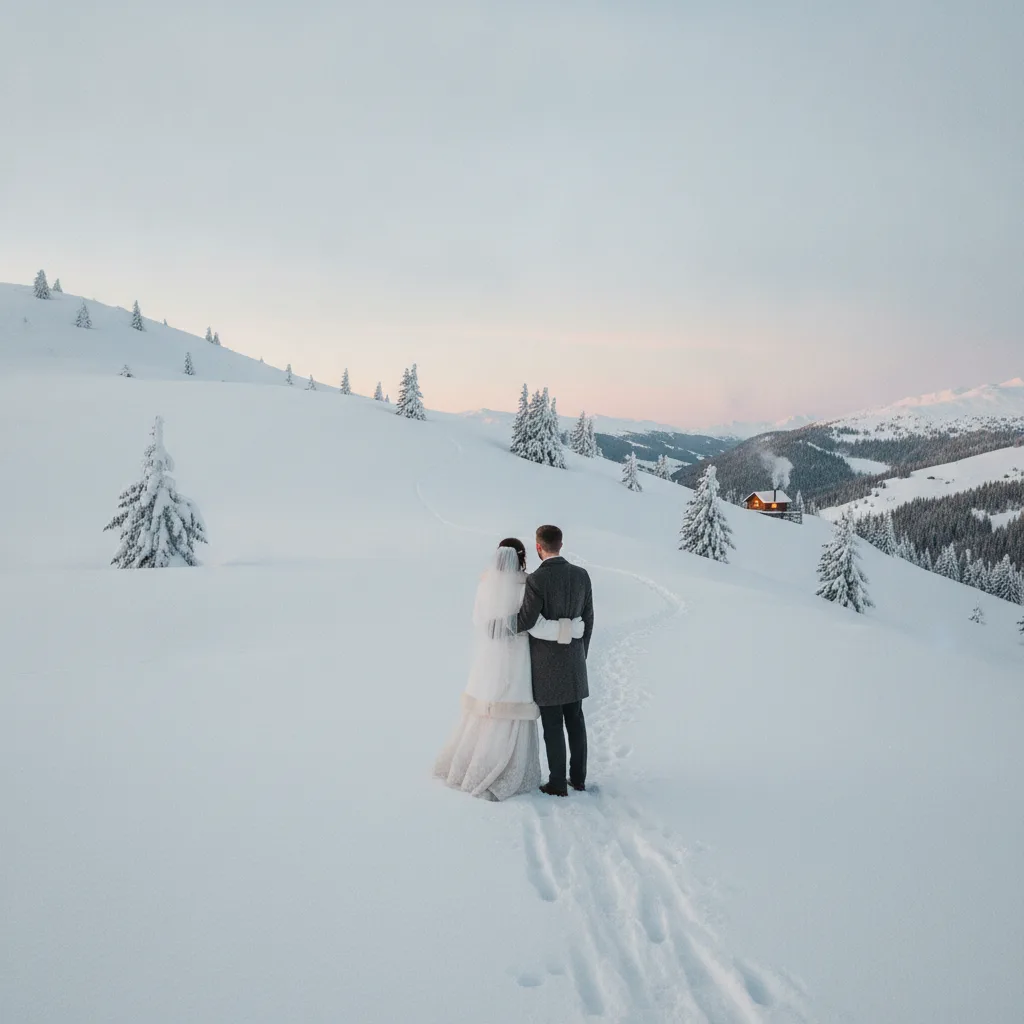
One of the great pleasures of an Alpine elopement is that the day can be shaped entirely around what you love. There is no venue coordinator managing the timeline, no seating chart to worry about, no obligation to perform for a room full of guests. You have the freedom to build something that is genuinely yours.
A well-designed winter elopement day in Megève or Courchevel might begin with a private breakfast in your chalet, followed by a snowshoe walk to a viewpoint for the ceremony at mid-morning light. The afternoon could be spent skiing together on a quiet piste, with portraits taken at the summit before the descent. As the light turns gold in the late afternoon, a final portrait session in the village or on a terrace overlooking the valley. Then dinner — a private table at a Michelin-starred restaurant, or a fondue by the fire in a mountain hut.
For couples who want to extend the experience, a two-day structure works beautifully. The first day is devoted to exploration and photography — arriving at locations, experiencing the landscape, building comfort with the camera. The ceremony takes place on the second day, when the couple is relaxed, connected, and fully present. This approach produces images of a completely different quality than a single rushed day, and it gives the photographer the time to tell the full story of your elopement rather than a highlight reel.
Why a Winter Elopement in the French Alps Rewards Intention
The French Alps in winter are not the easiest place to elope. They require planning, flexibility, the right clothing, and a team of professionals who know the terrain. But that is precisely what makes a winter elopement in the French Alps so memorable — it asks something of you, and it gives back in proportion. The images produced in this landscape, in this light, carry a weight and an atmosphere that simply cannot be manufactured elsewhere.
If you are a couple based in California or anywhere in the United States, planning an intimate ceremony that reflects the scale of your commitment and the depth of your aesthetic sensibility, this is the experience worth building. Explore the full portfolio and approach at linoludovic.fr to begin the conversation about your Alpine elopement.
FAQ
What is the best time of year for a winter elopement in the French Alps?
The most reliable window for snow in the French Alps runs from late December through late March, with January, early February, and March generally offering the best balance of snow coverage, stable weather, and manageable crowds. The Christmas and New Year period is visually spectacular but much busier and more expensive.
Do we need a legal ceremony in France for our elopement to feel like a real wedding?
Most American couples choose to complete the legal marriage at home and then hold a symbolic ceremony in the French Alps. With a bilingual celebrant, personal vows, and your chosen rituals, this symbolic ceremony carries all the emotional weight of a wedding day without the administrative complexity of a legal French ceremony.
What should we wear to stay warm during a winter elopement in the French Alps?
Think in layers: a thermal base layer such as merino wool, your wedding attire as the middle layer, and a warm down jacket for transitions between locations. Fleece-lined leggings under a gown, wool socks, waterproof boots, hand warmers, and simple, high-quality accessories like a fur stole or cashmere wrap will keep you comfortable and elegant in the snow.
How far in advance should we start planning a winter elopement in the French Alps?
Because winter in the Alps is both popular and unpredictable, it is wise to plan well in advance, especially if you hope to elope around Christmas, New Year, or peak winter weekends. Early planning also gives you time to secure experienced local professionals and to build in a backup date or location in case of storms.