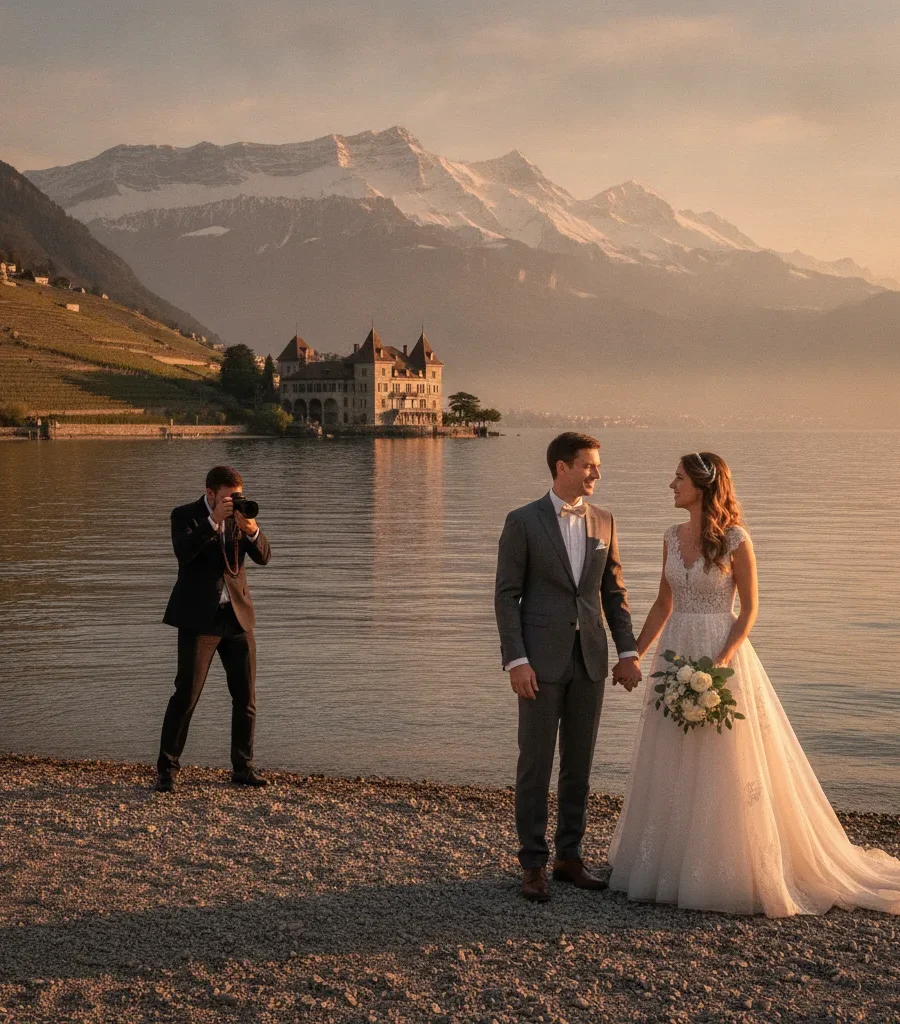
Lavender has become the visual shorthand for a Provence wedding, yet the most beautiful celebrations we photograph are rarely the ones built on that image alone. Planning an outdoor ceremony Provence lavender weekend means working with an agricultural calendar, a harsh midday sun and privately farmed land, not simply booking a backdrop. The good news is that with the right venue strategy and a precise timeline, you can have both the comfort your guests deserve and the editorial imagery you came for.
This guide covers bloom timing, field access, ceremony orientation, guest comfort and the questions to ask before booking a destination wedding photographer Provence couples can rely on. It is written for American couples and for the US planners who orchestrate their weekends from six time zones away.
Planning an Outdoor Ceremony Provence Lavender Fields
Reading time: ~9 min
- When the Lavender Actually Blooms
- Valensole, Sault or the Luberon
- Where the Ceremony Should Actually Take Place
- Ceremony Orientation, Light and Heat
- Access, Permissions and Respect for the Land
- The Weather Backup Plan
- Choosing the Right Photographer for an Outdoor Provence Wedding
- The Short Version
- Frequently Asked Questions
When the Lavender Actually Blooms
Typical bloom timing
The floraison de la lavande generally runs from mid-June to late July, with the exact window shifting according to altitude, rainfall and the specific variety planted.
Planning around peak colour
The most reliable period for deeply saturated fields falls roughly between the last week of June and the first week of July, which is why the best time for a lavender wedding Provence weekend is almost always late June. True lavender, Lavandula angustifolia, grows at higher elevations and tends to flower later than the hybrid lavandin planted across the lower plains, which gives you a second chance if the season runs early.
Using altitude to your advantage
Altitude flowering variation is your most useful planning tool. The Plateau de Valensole sits lower and is often harvested first, sometimes as early as the second week of July. Sault, in the Vaucluse, sits around 800 metres and regularly holds its colour one to two weeks longer, making a Sault lavender fields wedding or portrait session a genuine fallback when the plateau has already been cut. Lavender harvest timing is decided by the farmer, not by your calendar, and a dry spring can advance everything by ten days. No photographer, and no planner, can promise you a field in full bloom on a date chosen eighteen months in advance.
Important
Lavender is a crop before it is a backdrop. Harvest decisions are made days in advance by the grower, so always build your Provence destination wedding planning around a venue you love first and lavender portraits second.
Valensole, Sault or the Luberon
Each lavender region offers a different balance of drama, timing and logistics. The Plateau de Valensole delivers the vast geometric rows most couples picture, which explains the popularity of Valensole lavender wedding photos, but it is also the most visited area in July and the drive from Aix en Provence or the Luberon can eat into your evening. Sault is quieter and later. The Luberon Regional Natural Park and the Drôme Provençale combine smaller fields with olive groves, stone architecture and vineyard backdrops, which is often the more photogenic mix for a full day of coverage.
| Area | Typical peak bloom | Scenery | Best use |
|---|---|---|---|
| Plateau de Valensole | Late June to mid July | Vast open rows, big sky | Dramatic couple portraits, early morning |
| Sault, Vaucluse | Early to late July | Higher altitude, softer light, fewer visitors | Late season portraits and elopements |
| Luberon and Drôme Provençale | Mid June to mid July | Lavender with olive groves, villages, vineyards | Full day coverage with varied backdrops |
Where the Ceremony Should Actually Take Place
Host the ceremony at a Provençal estate
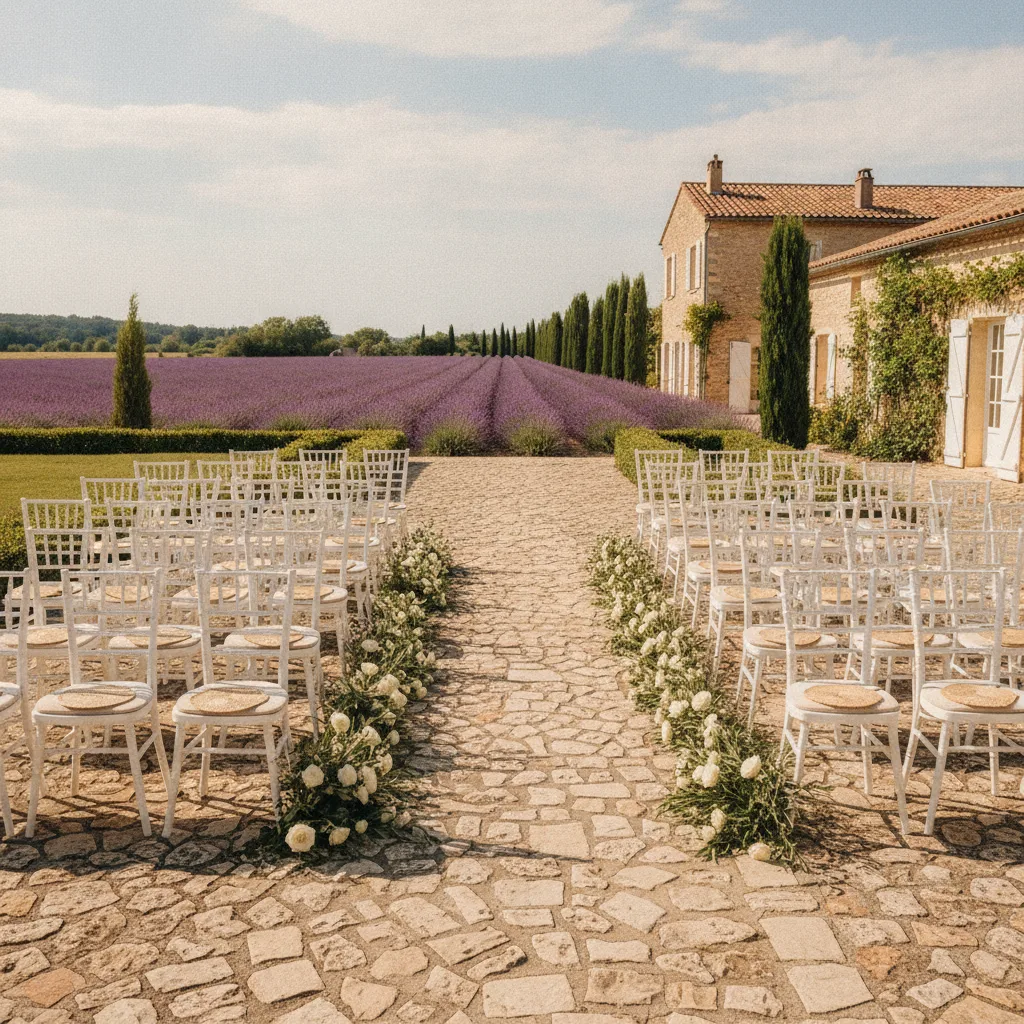
Here is the recommendation we give every planner who contacts us. Hold the ceremony at a domaine privé with gardens, terraces and shade, then reserve the lavender for portraits. A working field offers no shade, no level ground for seating, no power for sound and no acceptable restroom access for a hundred guests in formal attire. Provençal estates were built for this climate, with plane trees, cloisters, pergolas and thick stone walls that keep a cocktail hour civilised at 34 degrees.
Choose venues that minimise logistics
The region is rich in Provence wedding venues outdoor ceremonies suit perfectly. Château de la Gaude near Aix en Provence offers a formal garden ceremony setting of around 900 square metres accommodating up to 150 guests, with the bastide façade as an architectural backdrop. La Pousterle de Sabran provides outdoor spaces for humanist and religious ceremonies overlooking the Cèze valley, and like many estates it allows couples to bring their own photographer, florist and caterer. During venue scouting, look for a property that offers three or four distinct settings within walking distance, because moving 120 guests between locations in the heat is the fastest way to lose an hour of your timeline.
Frame the ceremony visually
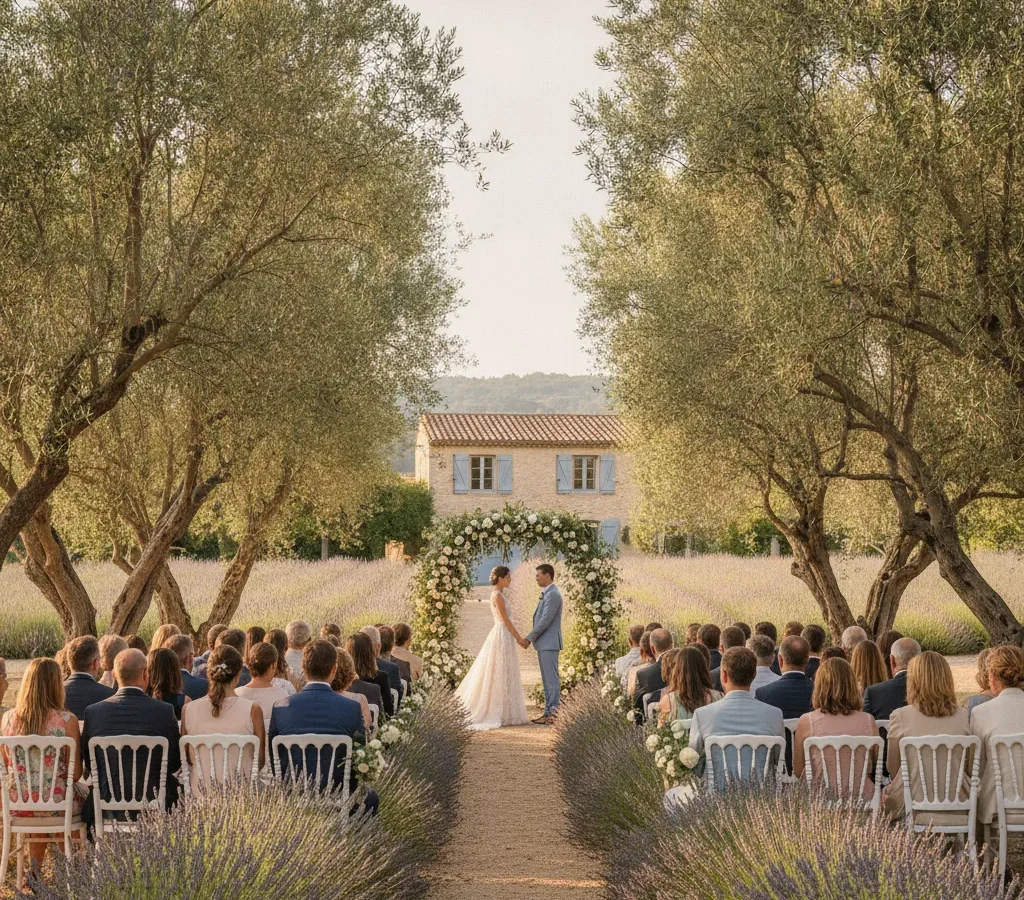
A structural ceremony backdrop matters more outdoors than indoors. In an open field or an olive grove, a simple wooden arch dressed with seasonal blooms gives the eye somewhere to settle and frames the couple cleanly against the horizon. Without it, wide ceremony images tend to read as empty. Our portfolio of château and estate ceremonies shows how a single well placed structure changes the geometry of every frame.
Ceremony Orientation, Light and Heat
Finding the right ceremony time
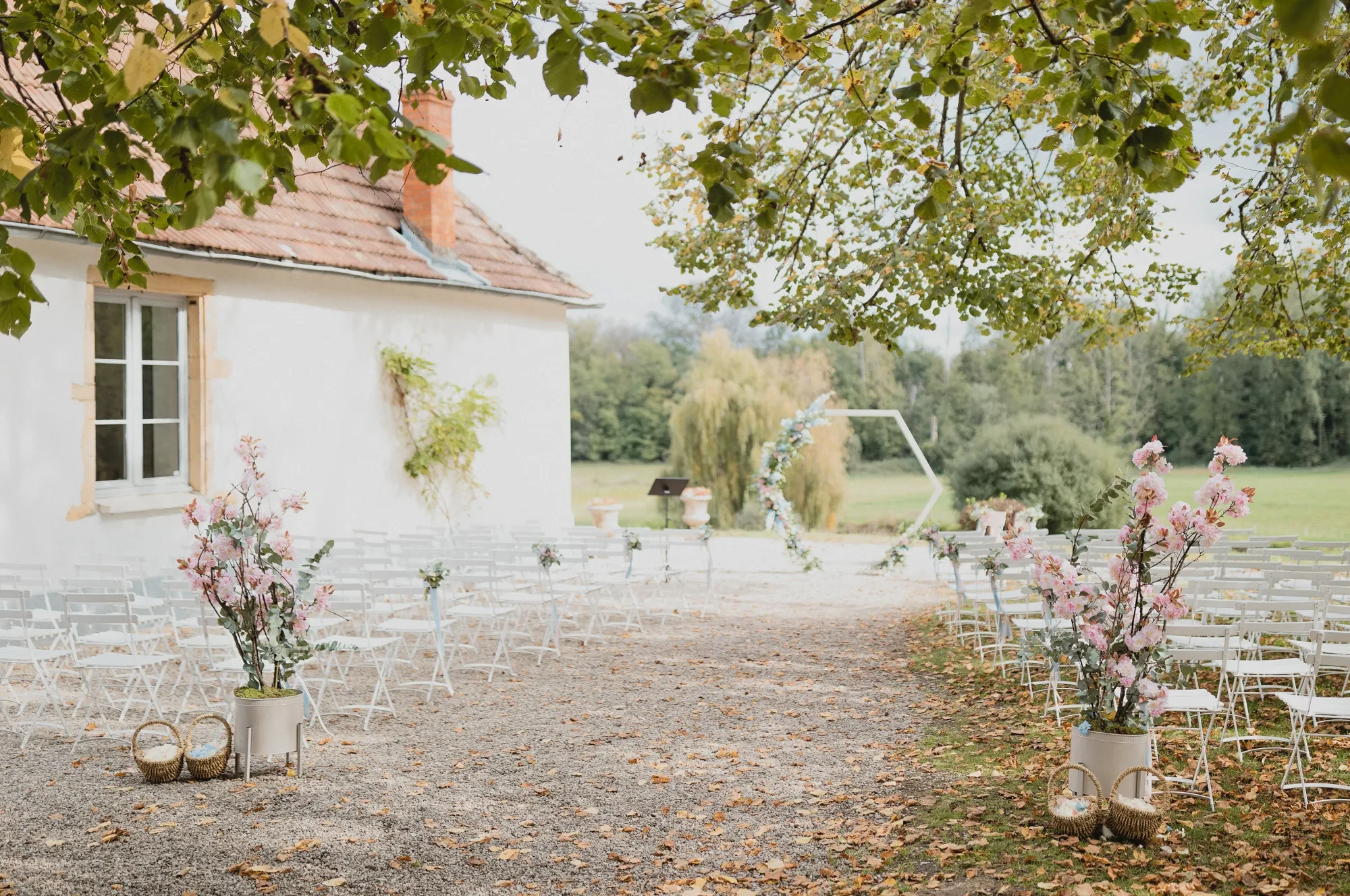
Ceremony orientation is a technical decision with emotional consequences. Guests should never face the sun directly, and the couple should not be squinting through their vows. We ask for the exact ceremony time early, then visit the site at that hour whenever possible to map shadow lines, because a terrace that looks idyllic at 11am can be brutal at 5pm. Soft directional light arrives in the final two hours before sunset, which in Provence in late June means a ceremony starting around 5.30pm or 6pm produces both comfortable guests and genuinely flattering images.
Scheduling portraits in the fields
For portraits, the two usable windows are early morning and golden hour. An outdoor portrait session Provence lavender fields deserve is best shot before 9am, when the air is cool, the bees are calm and the roadside pull offs are still empty, or in the last hour of daylight. Golden hour portraiture in a lavender row lasts about forty minutes before the colour turns grey, so portrait timing has to be written into the master timeline, not improvised. A lavender field engagement session Provence couples book the day before the wedding is often the smartest solution, removing all pressure from the wedding day itself.
Prioritising guest comfort
Guest comfort outdoor is not a detail. Shade management, chilled water on arrival, hand fans, parasols, insect awareness and a short ceremony length all matter. We have photographed enough July weekends to know that a thirty minute ceremony in the shade produces better reactions, and better photographs, than a fifty minute ceremony in full sun.
Access, Permissions and Respect for the Land
Agricultural field access is the subject most often overlooked in Provence destination wedding planning. Lavender fields belong to farming families whose annual income depends on that crop. Walking into rows, crushing plants or parking a shuttle on a verge is both disrespectful and, increasingly, actively policed during peak season. Private field permission is obtained in advance, usually through the venue, a local planner or the photographer’s own network of growers, and sometimes involves a fee.
Before you commit to any lavender element, confirm the following practical points with your planner or venue.
- Whether the field is privately owned, who grants access, and whether guests as well as the couple are permitted on the land
- What time slots are allowed, how many vehicles can park, and whether drones, amplified sound or seating installations are prohibited
- What happens if the field is harvested before your date, including an agreed alternative location within a short drive
For a Provence elopement lavender field ceremonies are far more realistic, since two people, two witnesses and an officiant leave almost no footprint and can be arranged with a single grower’s agreement. For a weekend of 130 guests, the estate plus portraits model remains the only responsible approach.
Good to know
Sound carries poorly in open countryside and the mistral can rise without warning, so any ceremony outside a sheltered garden needs lapel microphones and a wind protected speaker setup rather than a single handheld mic.
The Weather Backup Plan
A credible heat contingency plan and weather backup plan should be written, not assumed. It needs a covered or indoor ceremony space of equivalent capacity, a defined decision deadline on the morning of the wedding, a plan for moving florals and furniture, revised portrait locations with shade, and transport arrangements if the alternative is off site. Summer storms in Provence are short but violent, and the hour after one passes often produces the most beautiful light of the entire day. We always keep that window reserved in the timeline.
Choosing the Right Photographer for an Outdoor Provence Wedding
Ask to see complete galleries, not a curated selection of six lavender images. You want to see how a photographer handles a ceremony in hard midday sun, a candlelit dinner under plane trees and a dance floor at midnight. Ask how they combine a documentary wedding style with the directed editorial wedding photography moments that produce heirloom portraits. Ask about their second shooter policy, their backup equipment, their insurance, their familiarity with Valensole and Sault access, and their comfort working alongside an American production team across time zones.
For multi day celebrations, stamina and visual consistency across the welcome party, rehearsal dinner, wedding day and farewell brunch matter as much as a single beautiful frame. Based in France and working across French and Italian locations, we build each weekend around the venue, the light and the people, then deliver fine art albums handcrafted in France. You can see our approach to ceremonies and couple portraits at our wedding photography page, explore film coverage at our wedding videography page, or start a conversation.
The Short Version
Book a Provençal estate with gardens, shade and stone architecture. Schedule your wedding in the last week of June or the first days of July if lavender matters to you, and accept that nature decides the rest. Hold the ceremony late in the afternoon, keep your guests in the shade, and drive out to a permitted field at dawn or at golden hour for the portraits that will hang on your wall. Done in that order, lavender field wedding photography Provence is famous for becomes the finishing touch on a weekend that works, rather than a fragile idea the whole day depends on.
Frequently Asked Questions
Can we legally hold our civil ceremony in a lavender field in France?
No. French law requires the civil marriage to take place at a town hall, which is why most international couples complete the legal formalities at home and hold a symbolic or humanist ceremony in Provence. This gives you complete freedom over the location, the officiant and the timing.
How far in advance should we scout the fields?
We recommend a reconnaissance visit two to three months before the wedding to shortlist locations, then a final check in the week of the event to confirm the crop has not been cut. Growers rarely announce harvest dates more than a few days ahead.
Does lavender attract bees during portraits?
Yes, actively. Pollinator activity peaks in the middle of the day and drops sharply in the cool of early morning and after sunset, which is another reason to schedule portraits at the edges of the day rather than in the afternoon.
How much travel time should the timeline allow between an estate and the fields?
Allow a minimum of forty five minutes each way from the Luberon or Aix en Provence to the Plateau de Valensole, plus changing and walking time. If the drive exceeds an hour, a dedicated session on another day is usually the better decision.
What should we wear for a field portrait session?
Flowing fabrics, long veils and silk respond beautifully to the breeze and the evening light. Bring flat shoes for walking the rows, and consider a second evening look for the session, since lavender stems and dry soil are not kind to delicate hems.
Can the same approach work in autumn or outside the bloom season?
Absolutely. Olive groves, vineyards in September colour, formal gardens and warm stone façades photograph superbly year round, and the softer light of early autumn is often more forgiving than high summer.