Puglia is one of southern Italy’s best-kept secrets for destination weddings, and a Puglia masseria wedding is at the heart of that appeal. These historic fortified farmhouse estates offer a setting that is impossible to replicate anywhere else in Europe: thick stone walls, ancient olive groves, and sun-drenched courtyards create a backdrop that feels both cinematic and deeply authentic.
For American couples planning a destination wedding in Italy, and for the luxury planners who orchestrate these celebrations, Puglia masseria wedding experiences represent genuine exclusivity in a landscape that has barely changed in centuries. This guide covers everything you need to know before booking a masseria in Puglia, from venue costs and seasonality to logistics and photography considerations.
Puglia Masseria Wedding | The Complete Guide
Reading time: ~13 min
- At a glance
- What is a masseria and why is it ideal for a wedding in Italy?
- The best time of year for a Puglia masseria wedding
- How much does a masseria wedding in Puglia cost?
- Puglia masseria wedding vs Tuscany and the Amalfi Coast
- Logistical realities of a masseria wedding in Puglia
- How the exclusive-use model works for a Puglia masseria wedding
- What a wedding photographer needs to know before shooting at a masseria
- How far in advance should you book a masseria wedding in Puglia?
- Continuing your Puglia wedding journey
- Frequently asked questions
At a glance
Here is a summary of what this guide covers:
- What a masseria is and why its architecture makes it exceptional for weddings
- The best time of year to plan a Puglia masseria wedding for ideal light and weather
- How much a masseria wedding in Puglia costs, with a realistic breakdown
- How Puglia compares to Tuscany and the Amalfi Coast for destination weddings
- The logistical realities of a masseria wedding, from rural access to noise curfews
- What a wedding photographer needs to know before arriving at a masseria
- How far in advance to book and how the exclusive-use model works
What is a masseria and why is it ideal for a wedding in Italy?
A masseria is a traditional Puglian farmhouse estate, originally built as a self-sufficient agricultural complex producing olive oil, wine, and grain. Many were constructed between the 16th and 18th centuries and feature the defensive architecture typical of that era: thick perimeter walls, a central courtyard, and in some cases a fortified tower designed to protect the estate and its workers. Today, the finest masserie have been carefully restored into boutique hotel venues, blending centuries of history with modern comfort, private pools, and dedicated event spaces.
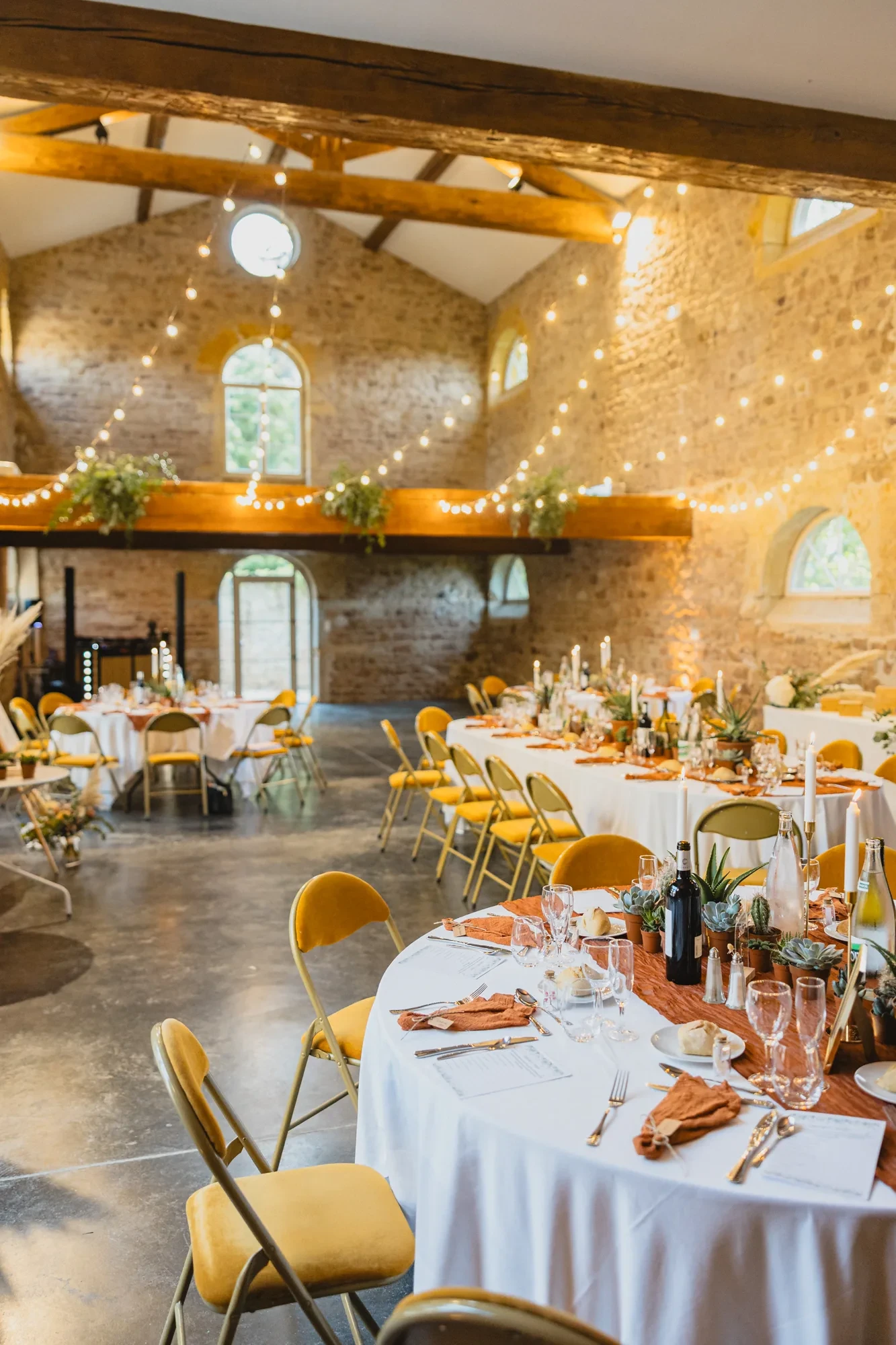
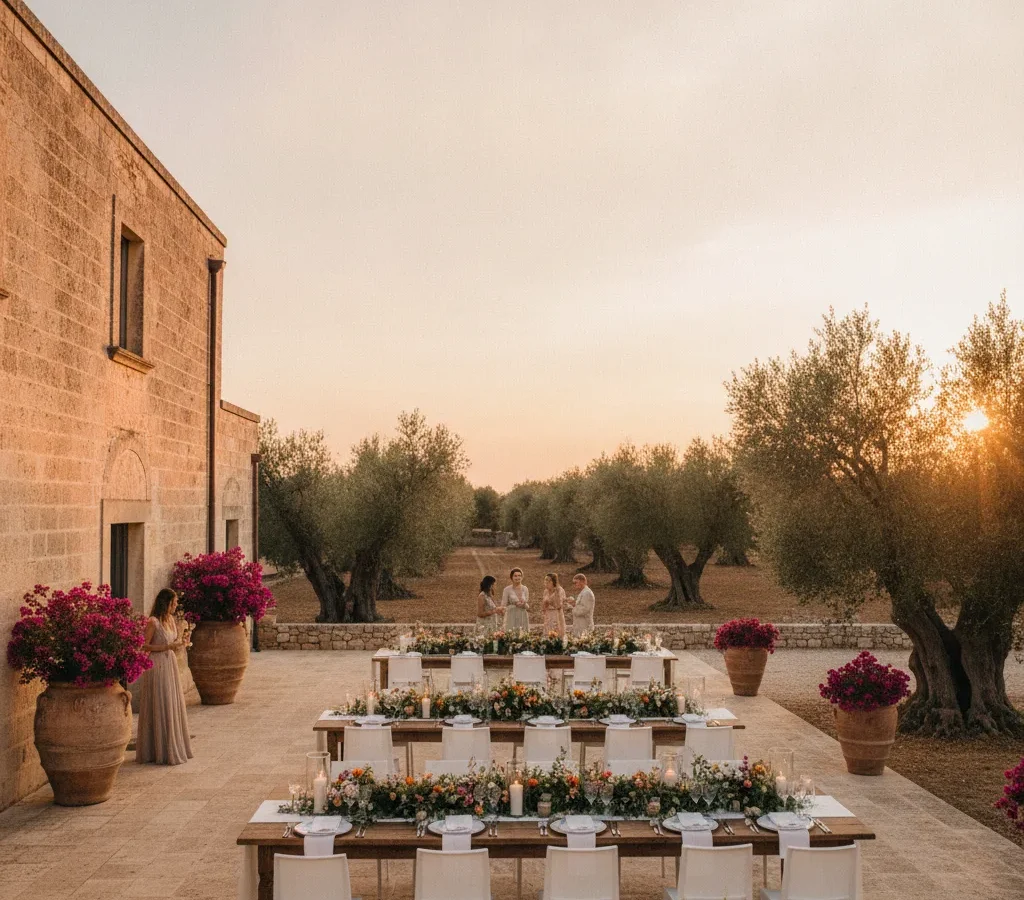
What makes a masseria so compelling as a wedding venue is the totality of the environment. The setting is not simply a building but an entire landscape. Guests walk through olive groves that are hundreds of years old. Ceremonies take place in stone courtyards where the walls themselves carry the warmth of the afternoon sun. Dinner unfolds al fresco under festoon lights strung between ancient trees, with long family-style tables stretching across the terrace. The agricultural estate becomes a world unto itself, and that immersive quality is precisely what couples from California and the wider United States are seeking when they choose to marry in southern Italy.
Puglia’s wedding venue scene is dominated by masserie, and for good reason. They offer a form of rustic elegance that is deeply photogenic without being theatrical. The warm stone textures, the whitewashed walls, the dry-stone boundaries, and the olive grove backdrop all work together to create images that feel timeless rather than staged.
The best time of year for a Puglia masseria wedding
Ideal months and seasonal light in Puglia
Seasonality matters enormously in Puglia, both for the comfort of guests and for the quality of light available to a photographer. The consensus among local planners and destination wedding specialists is clear: May, June, and September are the optimal months for a masseria wedding in Italy. Early October remains a viable option, offering softer light and fewer crowds, while July and August are generally considered too hot for comfortable outdoor celebrations, with temperatures regularly exceeding 35°C and a harsh midday light that creates difficult conditions for both guests and photographers.
During the shoulder months, the light in Puglia is extraordinary. The golden hour arrives later in the evening in June, giving photographers a generous seasonal light window for portrait sessions in the olive groves or along the estate’s stone walls. The heat is manageable, the landscape is green or transitioning to its characteristic dry gold, and the pace of the day feels unhurried. For couples planning a multi-day wedding celebration with a welcome dinner, a full wedding day, and a day-after brunch session, the shoulder season offers the most comfortable conditions across every event.
Good to know
Early October in Puglia often brings warm days, softer afternoon light, and a quieter atmosphere than peak summer. It is worth discussing this window with your planner and photographer if your preferred June dates are already taken.
How much does a masseria wedding in Puglia cost?
Typical budget for a Puglia masseria wedding
Cost is one of the most frequently asked questions about destination wedding Puglia planning, and the honest answer is that it varies considerably depending on the estate, the guest count, and the number of days involved. Venue hire for exclusive-use masserie typically starts at around 2,500 to 5,000 euros for entry-level properties, rising to approximately 15,000 euros for the most sought-after estates for a full weekend buyout. A multi-day celebration for around 50 guests, including accommodation, catering, and venue fees, can be structured for under 75,000 euros, which positions Puglia as genuinely competitive compared to Tuscany or the Amalfi Coast for comparable levels of exclusivity.
The table below illustrates how costs and key features compare across three major Italian destination wedding regions.
| Region | Typical exclusive-use venue fee | Relative cost level | Primary venue style | Crowd level |
|---|---|---|---|---|
| Puglia (masseria) | From 2,500 to 15,000 euros | Competitive | Fortified farmhouse estate | Lower saturation |
| Tuscany | Higher, fewer competing estates | Premium | Villa, castello | High |
| Amalfi Coast | Higher, limited venue supply | Premium to ultra-premium | Coastal hotel, cliff-side villa | Very high |
Beyond the venue fee itself, couples should budget for catering, florals, entertainment, accommodation for guests, photography and videography, and coordination fees. Puglia’s advantage is that it offers more competing estates, which keeps pricing more accessible without sacrificing the sense of privacy and refinement that defines a high-end destination wedding.
Puglia masseria wedding vs Tuscany and the Amalfi Coast
The comparison between Puglia and more established Italian wedding destinations is one that couples and planners raise regularly. Tuscany and the Amalfi Coast have dominated the destination wedding Italy narrative for decades, but Puglia offers something meaningfully different rather than simply a cheaper alternative.
Where Tuscany delivers rolling hills and Renaissance architecture, and the Amalfi Coast offers dramatic coastal scenery, a masseria wedding in Puglia provides a form of authenticity that feels less curated and more genuinely rooted in place. The Valle d’Itria, with its iconic trulli dotting the landscape around Alberobello (a UNESCO World Heritage Site), and the wild beauty of Salento in the south create a visual context that no other Italian region can replicate. For couples who want their wedding to feel like an immersive cultural experience rather than a luxury hotel event, Puglia is the stronger choice.
For US luxury planners, Puglia also presents a practical advantage: the region has fewer competing high-profile weddings on any given weekend during peak season, which means more flexibility from local vendors, caterers, and florists who are not simultaneously stretched across multiple events.
Logistical realities of a masseria wedding in Puglia
Transport, access, and venue regulations
Planning a destination wedding Puglia requires a clear understanding of the logistical landscape, and the masseria setting introduces specific considerations that differ from urban or coastal venues. The primary gateways to the region are Bari Karol Wojtyła Airport (BRI) and Brindisi Airport (BDS), both of which are served by international connections, including routes from major US hubs via European connections.
From the airport, the journey to a rural masseria is rarely straightforward. Many estates are reached via gravel roads or narrow unpaved lanes that are not suited to standard coaches or large vehicles. Organising group transfers using minibuses is strongly recommended, and guests should be advised about footwear: stone courtyards and gravel paths make stilettos impractical, with flat sandals or block heels being far more appropriate for the terrain.
Buffer time must be built into every transfer schedule. Rural driving conditions in Puglia mean that journeys frequently take longer than digital maps suggest, and a ceremony delayed by late-arriving guests is a problem that cascades across the entire day’s timeline. Experienced planners working in the region factor this into their run-of-show documents as a matter of course.
Noise curfews are another variable that couples and planners must investigate before signing a venue contract. Not every masseria allows outdoor celebrations to continue into the early hours of the morning, and the difference between a venue that cuts music at midnight and one that allows dancing until 2am can significantly shape the energy and coverage of the wedding reception.
Important
Always confirm the venue’s noise curfew policy in writing before signing. Some masserie require music to move indoors or to cease entirely by midnight, which affects both the guest experience and the scope of late-night photography coverage.
How the exclusive-use model works for a Puglia masseria wedding
The exclusive-use buyout model is the standard approach for masseria weddings in Puglia. When a couple books an exclusive-use wedding venue Italy, they are reserving the entire estate for their party, typically for a minimum of two to three nights. No other guests, events, or hotel bookings take place on the property during that period. The estate becomes entirely theirs.
This model has significant implications for how a wedding weekend unfolds. It enables a genuine multi-day wedding celebration structure: a welcome dinner on the evening of arrival, the full wedding day, and a farewell brunch or pool day on the morning of departure. Guests who have flown across the world from California or New York are not simply attending a single event; they are inhabiting a place together for several days. The masseria becomes a shared home for the duration, and that intimacy shapes the entire emotional register of the celebration.
For photographers, the exclusive-use model is equally valuable. It allows for unhurried access to every corner of the estate across multiple days, pre-wedding portrait sessions in the olive groves without strangers in the background, and the ability to document the full arc of a multi-day story rather than a single compressed event.
What a wedding photographer needs to know before shooting at a masseria
Planning and shooting strategy for masseria weddings
Shooting a Puglia masseria wedding requires both technical preparation and a genuine understanding of the venue type. The visual language of a masseria is built on warm stone textures, dappled light filtering through ancient olive trees, and the contrast between whitewashed walls and the deep blue of the Puglian sky. A photographer who arrives expecting the manicured symmetry of a French chateau or the dramatic coastal light of the Amalfi will need to recalibrate their approach.
The most important preparation is scouting. Every masseria has its own layout, its own relationship with the sun, and its own set of compositional opportunities. Understanding where the light falls at golden hour, where the courtyard opens to the sky, and which corners of the estate offer depth and texture is work that must be done before the wedding day begins. Ideally, this happens during the welcome dinner the evening before, which provides a natural opportunity to walk the property in real conditions.
Timeline coordination is equally critical. The rural access challenges described above mean that a photographer working at a masseria must build flexibility into their portrait schedule. If the ceremony runs ten minutes late because a transfer arrived behind schedule, the window for golden hour portraits may narrow significantly. Communicating clearly with the planner about buffer time and sunset timing is not optional; it is part of delivering the editorial light that couples are expecting when they book a destination wedding photographer for an estate of this caliber.
For multi-day coverage, stamina and consistency are non-negotiable. A welcome dinner, a full wedding day, and a day-after brunch session across three days demand sustained creative energy and a coherent visual approach. The couples who choose a masseria wedding in Puglia are investing in a complete experience, and their photography should reflect that totality, from the first aperitivo hour to the last morning swim.
At Lino Ludovic, we approach Puglia masseria weddings as immersive storytelling assignments. Our role is to document the full emotional arc of a multi-day celebration with the discretion of a documentary observer and the eye of an editorial photographer. You can explore our approach to destination wedding photography on our website, and our portfolio reflects the kind of cinematic, light-driven work that these extraordinary venues deserve.
How far in advance should you book a masseria wedding in Puglia?
The most sought-after masserie in Puglia book up quickly, and the recommendation from planners and venue specialists is consistent: begin your venue search 18 to 24 months before your intended wedding date. This lead time is not conservative caution but a practical necessity. The best exclusive-use wedding venues in Italy have limited availability, and the most desirable weekends in May, June, and September are typically reserved well over a year in advance.
The same principle applies to your photographer. A masseria wedding is a complex, multi-day production, and the photographers who specialise in this kind of work, with the language skills, cultural fluency, and logistical experience required, have calendars that fill up at the same pace as the venues themselves. Securing your visual artist at the same time as your venue, rather than as an afterthought, is one of the most important decisions you will make in the planning process.
Continuing your Puglia wedding journey
A Puglia masseria wedding offers something that very few destinations in Europe can match: the combination of authentic historical architecture, extraordinary natural light, an immersive multi-day format, and a level of exclusivity that feels genuine rather than manufactured. For American couples who want their destination wedding in Italy to feel rooted in place and alive with emotion, the masseria is not simply a venue choice. It is a statement of intent.
For the planners and photographers who bring these celebrations to life, Puglia rewards preparation, curiosity, and a deep respect for the landscape that makes it so extraordinary. If you are beginning to plan a destination wedding in southern Italy and want to discuss how we document these celebrations, we invite you to visit our contact page and start the conversation.
FAQ
Is it possible to have a legally recognised civil ceremony at a masseria in Puglia?
Yes, civil ceremonies can be legally recognised at many masserie in Puglia, provided the venue has the necessary municipal authorisation. Your wedding planner will coordinate with the local comune (town hall) to arrange the officiant and the required paperwork. Non-Italian couples will also need to obtain a Nulla Osta, a certificate of no impediment, from their home country’s embassy or consulate in Italy before the ceremony.
Do most masserie in Puglia have on-site accommodation for guests?
Many masserie have been converted into boutique hotels with a limited number of rooms or suites, typically enough to accommodate the immediate wedding party and closest family members. For larger guest lists, nearby agriturismo properties, trulli rentals, and hotels in towns such as Ostuni, Fasano, or Lecce are commonly used to supplement on-site accommodation. Group transfers between accommodation and the estate are standard practice.
What language should we expect our vendors in Puglia to speak?
English proficiency varies considerably among local vendors in Puglia. While many wedding planners and photographers who specialise in international destination weddings are fluent in English, caterers, florists, and venue staff may have limited English. Working with a planner or a photographer who is fully fluent in English and experienced with American clients is strongly recommended to avoid communication gaps across time zones during the planning process.
Are there restrictions on floral installations or decor at a masseria?
Some masserie, particularly those with listed heritage status, impose restrictions on structural alterations or the use of open flames. Candles in lanterns or enclosed holders are generally permitted, but large-scale installations that require drilling or attaching to historic stonework may be subject to approval. Your planner should review the venue’s decor policy in detail during the site visit and contract negotiation phase.
What is the typical guest count for a masseria wedding in Puglia?
Most masserie are best suited to intimate or mid-size celebrations. Guest counts of 50 to 120 are most common, as they allow for the relaxed, communal atmosphere that defines the masseria experience. Very large weddings of 200 or more guests are possible at some of the larger estates but require significant logistical planning, particularly around catering, seating, and group transfers.