Your wedding photographs have come back from France or Italy, the gallery is stunning, and now the files sit quietly on a hard drive. A wall art gallery of wedding photos at home is the most direct way to bring that weekend back into daily life, whether in the hallway you walk through every morning or above the sofa where you host friends.
Done well, a wedding photo wall reads like a curated exhibition rather than a scrapbook. Done carelessly, it looks crowded and accidental. This guide covers selection, print sizes, frames, layout planning and installation, so the work you commissioned in Europe lives on your walls with the same restraint and elegance it had on the day.
Wall Art Gallery Wedding Photos Home – 2026 Guide
Reading time: ~10 min
- Why a wedding photo wall belongs in your home
- How to choose the right images
- How many photographs should go on a gallery wall
- Gallery wall layouts that actually work
- Print sizes, aspect ratio and resolution
- Frames, mats and glazing
- Framed print, canvas, acrylic or metal
- How high to hang, and the 57 inch hanging rule
- Planning the wall before you drill
- Color calibration and getting the print to match the file
- Working with your photographer on the finished pieces
- The four decisions behind a lasting wedding photo wall
- Frequently asked questions about wedding photo walls
Why a wedding photo wall belongs in your home
A fine art album is an intimate object, opened deliberately, usually with someone sitting beside you. Wall art works differently. It is ambient, permanent and shared with everyone who enters the room.
For couples who invested in a multi day celebration abroad, the welcome party, the ceremony, the reception in a chateau courtyard, wall display is the natural extension of that investment.
It also solves a common frustration we hear from clients months after delivery, which is that hundreds of images remain unseen. Choosing eight or twelve photographs for a wall forces an editorial decision, and that decision is what turns a documentation into wedding photo wall decor with genuine presence.
How to choose the right images
Start with the story of the weekend
Start with narrative, not with favorites. Deciding what story the gallery should tell before selecting anything is a principle that holds for every wall that works well. A wedding weekend already has a structure, so let the wall borrow it.
A useful way to organise your shortlist is to think in chapters and pick one or two images from each:
- Before the ceremony: preparation, the dress, the rings, an architectural detail of the venue.
- The ceremony: the procession, the vows, one wide frame that shows the place itself.
- Portraits: the couple in the landscape, one family or wedding party image.
- Celebration: a speech, dancing, a candid guest moment with real energy.
- A closing image: a quiet exit frame, or the villa at dusk.
Mix scale as well as subject, combining portraits, candids and details rather than filling a wall with posed frames only. Pay attention to portrait versus landscape orientation too, since a gallery built entirely from one shape looks static. Black and white alongside color is entirely possible when the editing style is consistent, which is why a cohesive color profile across the whole set matters more than the question of monochrome itself.
How many photographs should go on a gallery wall
There is no fixed number, because the answer depends on wall width, furniture beneath it and the density you want. As a starting point, three to seven prints suit a compact wall or a display spread across several rooms, five to nine works comfortably on a wall of roughly five to ten feet, and a salon style gallery wall can carry twelve to twenty pieces, provided frame finishes, mats and spacing stay disciplined.
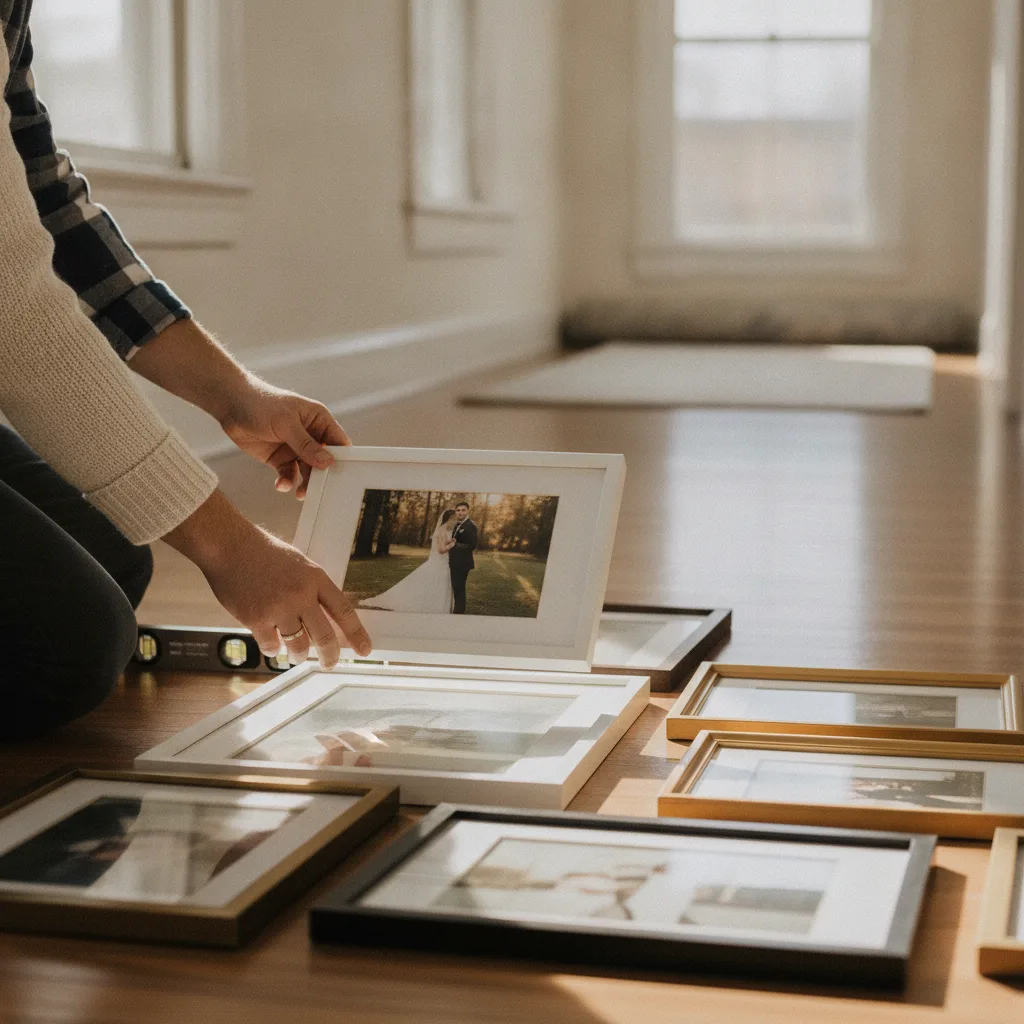
Treat these as ranges to test with paper templates, not as rules. In practice, most living rooms look better with fewer, larger pieces than with many small ones.
Gallery wall layouts that actually work
Choose a layout that suits your room architecture
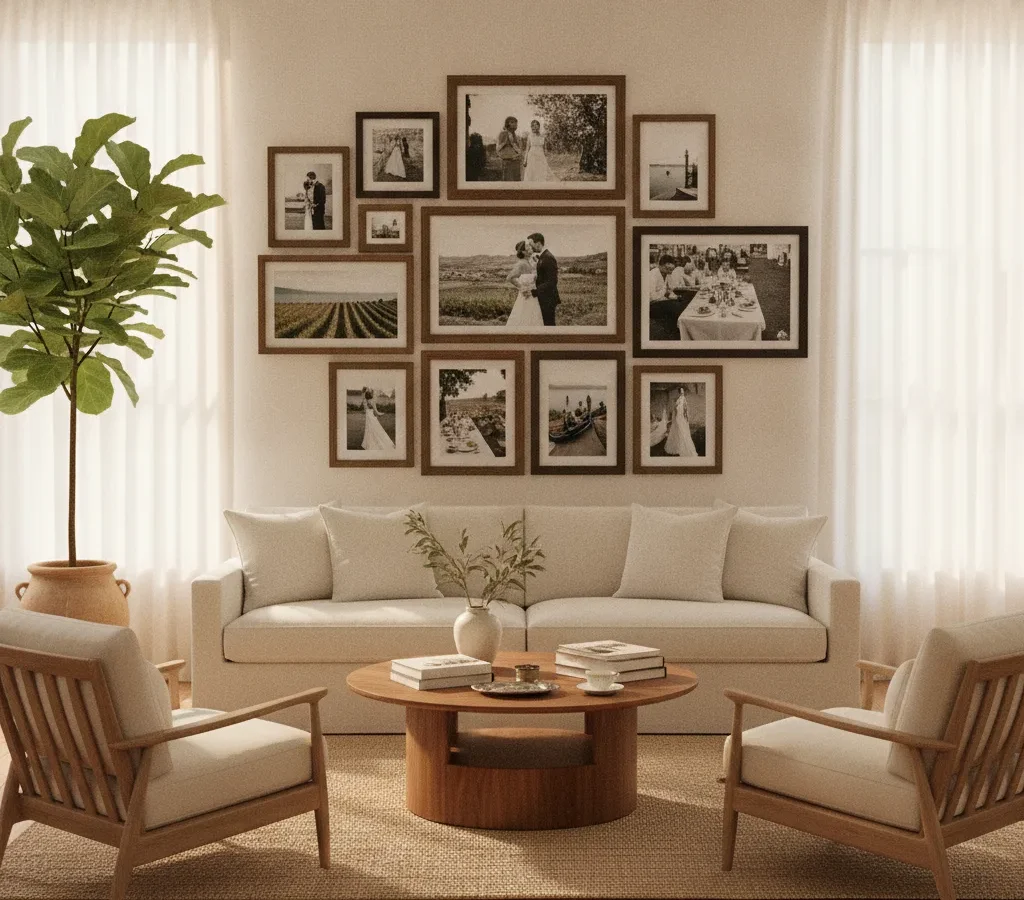
Four arrangements cover almost every situation. A grid layout, with identical frame sizes and even spacing, suits modern interiors and looks deliberate with very little effort. A salon style gallery wall mixes sizes and orientations around a visual anchor piece and suits older or more eclectic homes. A chronological timeline layout runs beautifully along a hallway or up a staircase, following the day from getting ready to the last dance. A triptych arrangement, three coordinated prints from one scene, is the most restrained option and often the most elegant above a console.
Whatever the structure, build outward from one anchor photograph. A wide ceremony frame or a couple portrait in the landscape makes the strongest hero print. A common recommendation is to use two or three larger anchor frames, such as 16 by 20 or 18 by 24 inches, supported by 11 by 14, 8 by 10, 5 by 7 and 4 by 6 inch pieces. If you are exploring wedding photo collage wall ideas, keep the collage principle in the layout rather than inside a single frame, since multi aperture mounts tend to date quickly while a true gallery grouping does not.
Good to know
Distribute your darkest images and heaviest frames diagonally across the composition rather than grouping them on one side, a balancing technique that stops the wall from feeling visually lopsided.
Print sizes, aspect ratio and resolution
Choose sizes only after checking the aspect ratio and print resolution of the original file. A photograph composed at 3:2 does not become 8 by 10 without losing something from the edges, and on a wedding image that loss is often a hand, a shoulder or the architectural line that gave the frame its balance. Ask your photographer which crops are safe.
For a living room, a hero print of 16 by 20 inches or larger holds the wall, with 20 by 30 or 24 by 36 inches appropriate for a genuine feature wall. When a single large piece sits above a sofa, aim for a long edge of roughly two thirds of the sofa width, a proportion widely used by professional framers.
Frames, mats and glazing
Unifying the wall with consistent framing
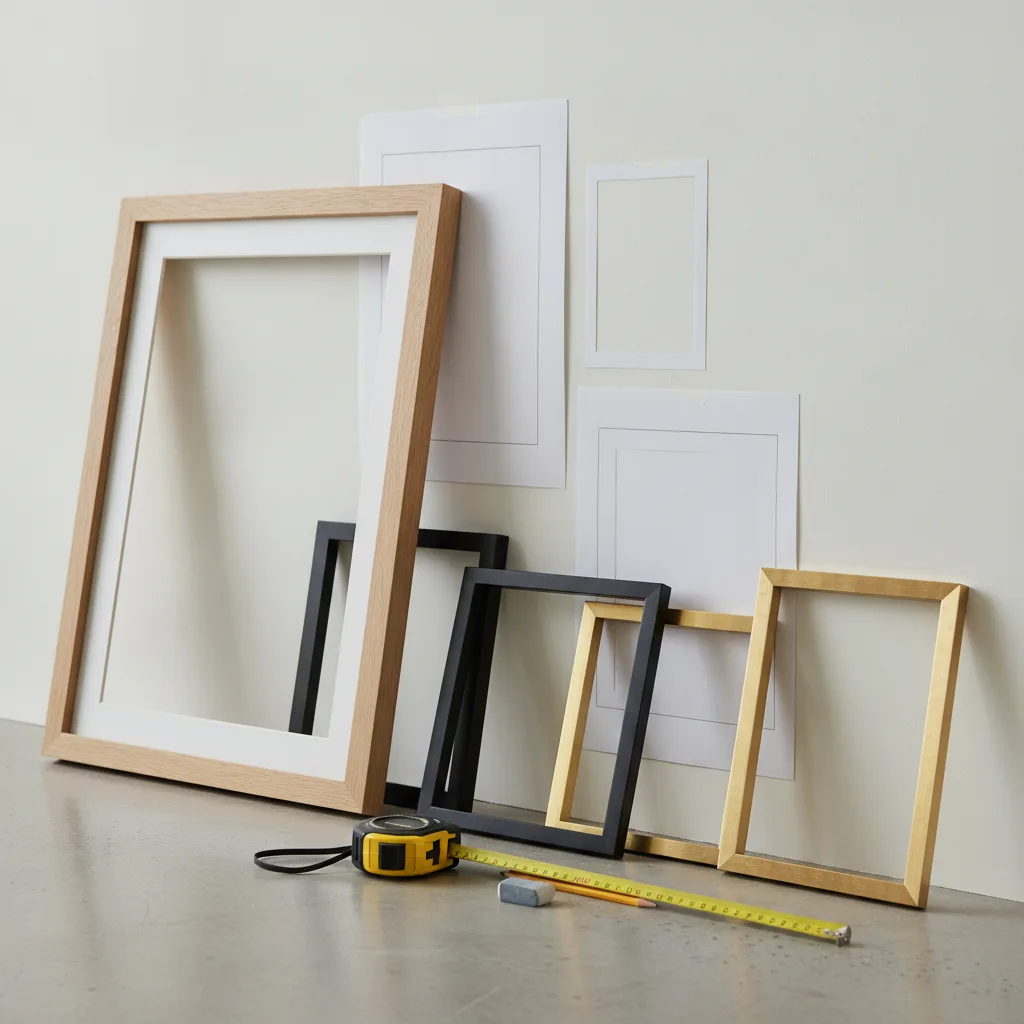
The best frames for wedding photos are the ones that disappear. Natural oak suits warm interiors, black suits contemporary rooms with high contrast, brass and warm metallics read more traditional, and white frames sit quietly in minimal spaces. Frame finish cohesion is the single variable that separates a curated wall from a cluttered one, and limiting a gallery to two or three finishes and one or two mat colors is generally recommended.
Mats do more than decorate. A generous mat border width gives a small print authority, separates the image from the glazing and unifies photographs of different dimensions. For pieces you intend to keep, specify archival paper, an acid free mat and hinging tape, alongside UV protective glazing or museum glass for the hero piece. UV protection slows fading, it does not stop it, so keep framed wedding photos for home out of direct sunlight regardless of the glass specified, and away from radiators and damp bathrooms.
Framed print, canvas, acrylic or metal
The material changes the mood of the image as much as the frame does. This comparison summarises how the main options behave in a domestic interior.
| Format | Best suited to | Presentation | Points to check |
|---|---|---|---|
| Framed photographic print | Heirloom portraits, gallery walls, formal interiors | Archival paper, acid free mat, UV protective glazing | Reflections, weight, hanging hardware supplied |
| Canvas | Large single portraits, softer romantic rooms | Gallery wrap canvas or floater frame for a finished edge | Texture slightly softens fine detail |
| Acrylic | Contemporary spaces, saturated color, high impact | Glossy, seamless, no visible frame | Reflections near windows, fingerprints, packaging |
| Metal | Modern interiors, architectural and high contrast images | Sleek, frameless, variable surface finish | Color rendering, reflectivity, mounting system |
| Photo tiles or light panels | Rentals, temporary or frequently rearranged displays | Adhesive mounting, repositionable | Wall compatibility, weight limits, paint removal risk |
For a wedding, we generally recommend framed archival prints for the gallery and reserving canvas or acrylic for one statement piece, so the wall keeps a consistent visual language.
How high to hang, and the 57 inch hanging rule
Most wedding photo wall display ideas fail at the installation stage, usually because everything is hung too high. Eye level placement is the standard that museums use, and the main piece is generally centred approximately 57 to 60 inches from the floor.
The 57 inch hanging rule refers to the centre of the composition, not the top of the frame, and for a multi frame gallery you apply it to the visual centre of the whole arrangement. Above a sofa or a bed, leave a deliberate gap between the furniture and the lowest frames rather than pushing the group toward the ceiling, adjusting for sofa height and ceiling proportion.
Planning the wall before you drill
Test your composition with templates
Never mark a wall from imagination. The reliable method is slow and costs nothing.
- Measure the wall and the furniture beneath it, then decide the total width and height of the gallery.
- Record the external dimensions of each frame, and the distance between the top of the frame and its hanging fixture.
- Cut paper templates, arrange them on the floor, then photograph the arrangement.
- Transfer the templates to the wall with painter’s tape and live with the mock up for a day or two.
- Mark the hanging points only once the composition looks right from where you actually sit.
That painter’s tape mock up stage is what makes the difference between a wall you enjoy and a wall you patch. If you are renting, adhesive hanging systems or picture ledges allow you to hang wedding photos without damaging walls, though you should test on an inconspicuous area first and respect the manufacturer’s weight limits. Mixtiles, for example, suggests around one to two inches between adhesive tiles, while Inkifi recommends roughly five to fifteen centimetres between framed pieces, and other guides suggest one and a half to three inches. Consistency of spacing matters more than which figure you adopt.
Color calibration and getting the print to match the file
Coordinate color management with your lab and photographer
A print that looks dull or too warm is usually a color management problem rather than a photography problem. Screens are brighter than paper, household lighting is warm, and many consumer labs apply automatic corrections that override the photographer’s intent.
Ask your lab whether color calibration is manual or automatic, whether auto correction can be disabled, and whether they can print your calibrated files with the embedded color profile untouched. Order a single test print of the hero image before committing to a full set, and judge it in daylight rather than under evening lamps.
Important
Before ordering custom wedding photo wall art, confirm with your photographer that the delivered files are print resolution rather than web sized, and ask which specific crops preserve the original composition.
Working with your photographer on the finished pieces
The people who made the images are the best guides to displaying them. As a French based photographer working across chateaux, the Riviera and Italian villas for American couples and their planners, we think of delivery as a starting point, not an end.
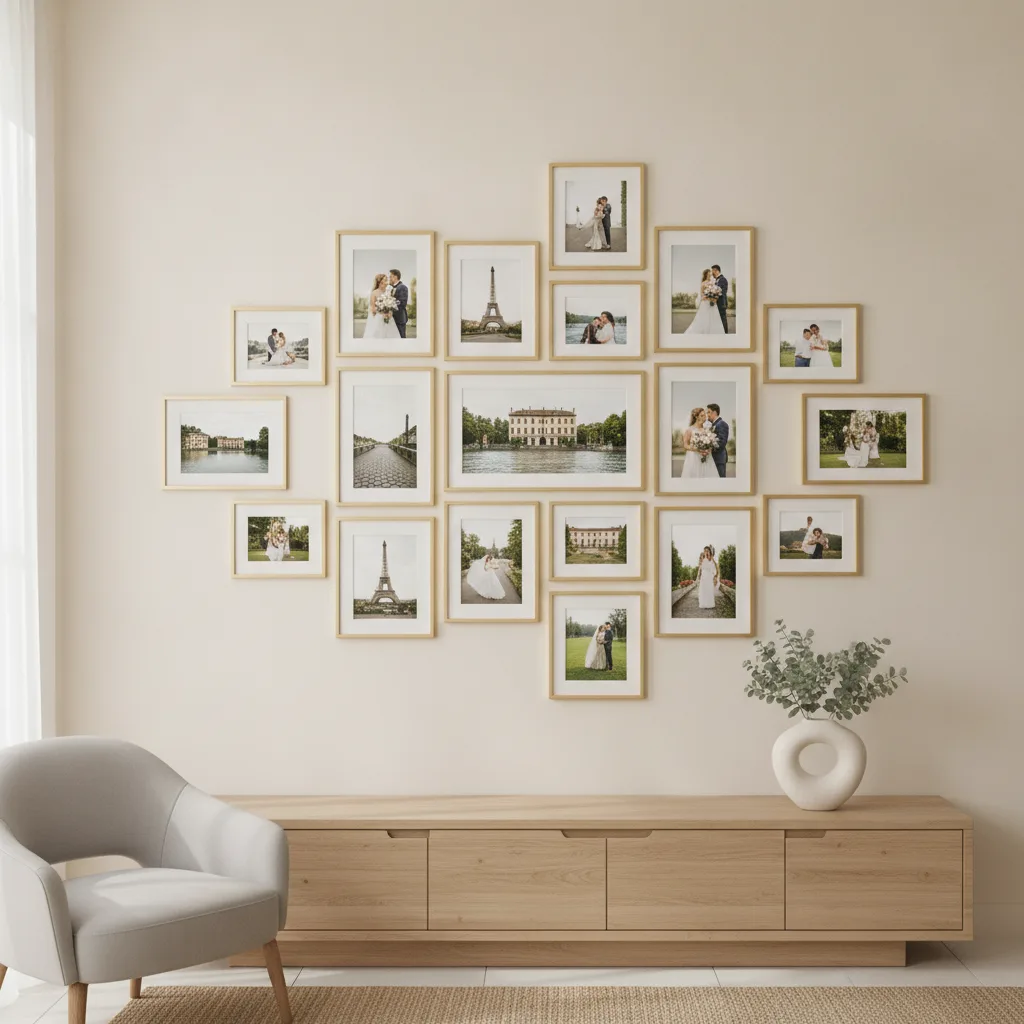
Fine art albums handcrafted in France remain the heirloom object, and a considered selection of wedding prints for the living room extends the same craft to the wall.
When a client asks us to help with a wedding photo gallery wall, we usually propose an anchor photograph, a coherent set of supporting frames and a single editing treatment across all of them, so the group reads as one work.
The four decisions behind a lasting wedding photo wall
Knowing how to create a wedding photo gallery wall at home comes down to four decisions: which images tell the story, which anchor piece carries the wall, which frames and materials hold the set together, and where exactly the composition sits in relation to the room.
Take the time to mock up the layout, protect the prints with archival materials and UV protective glazing, and resist the urge to hang everything. The restraint you applied to your wedding design is the same restraint that will make these photographs look extraordinary ten years from now. If you would like help selecting the anchor image and supporting frames for your own wall, get in touch to talk through the set.
Bringing your wall art gallery wedding photos home
Your wedding wall should feel as intentional as the celebration itself. By choosing a clear narrative, limiting the number of images, keeping frames and materials cohesive and hanging everything at a comfortable height, the gallery becomes part of how you live rather than a project you finish once. Revisit the selection over time, swapping individual pieces while preserving the structure, so the wall art gallery of wedding photos at home continues to reflect your life together.
Frequently asked questions about wedding photo walls
Can I add engagement session images to a wedding gallery wall?
Yes, and it often improves the wall. An editorial engagement session in Paris, Provence or Lake Como usually produces wider, quieter frames that balance the density of wedding day images, provided the editing style and color treatment match across the set.
Should I display images from every part of a multi day wedding weekend?
One image per event is usually enough. A welcome dinner frame, a ceremony frame, a reception frame and a farewell brunch frame give the wall a chronological timeline layout without turning the room into a full gallery of the weekend.
How do I keep a gallery wall from ageing badly as the house changes?
Choose frames that match the architecture rather than the current decor, keep mats neutral, and use a single hanging system so individual pieces can be swapped later without new holes in the plaster.
What should I ask a framing or printing supplier before ordering?
Ask about paper types and finishes, whether custom aspect ratios are available, whether glazing is UV protective, what hanging hardware is included, how large pieces are packaged, and what the procedure is if an item arrives damaged. Made to order pieces often fall outside standard return policies, so confirm this in writing.
Is a gallery wall a good idea in a hallway with artificial light only?
It can be, as long as you avoid high gloss surfaces that mirror ceiling lights. Matte archival paper behind museum glass, or a low reflection glazing, keeps the images readable in narrow spaces.