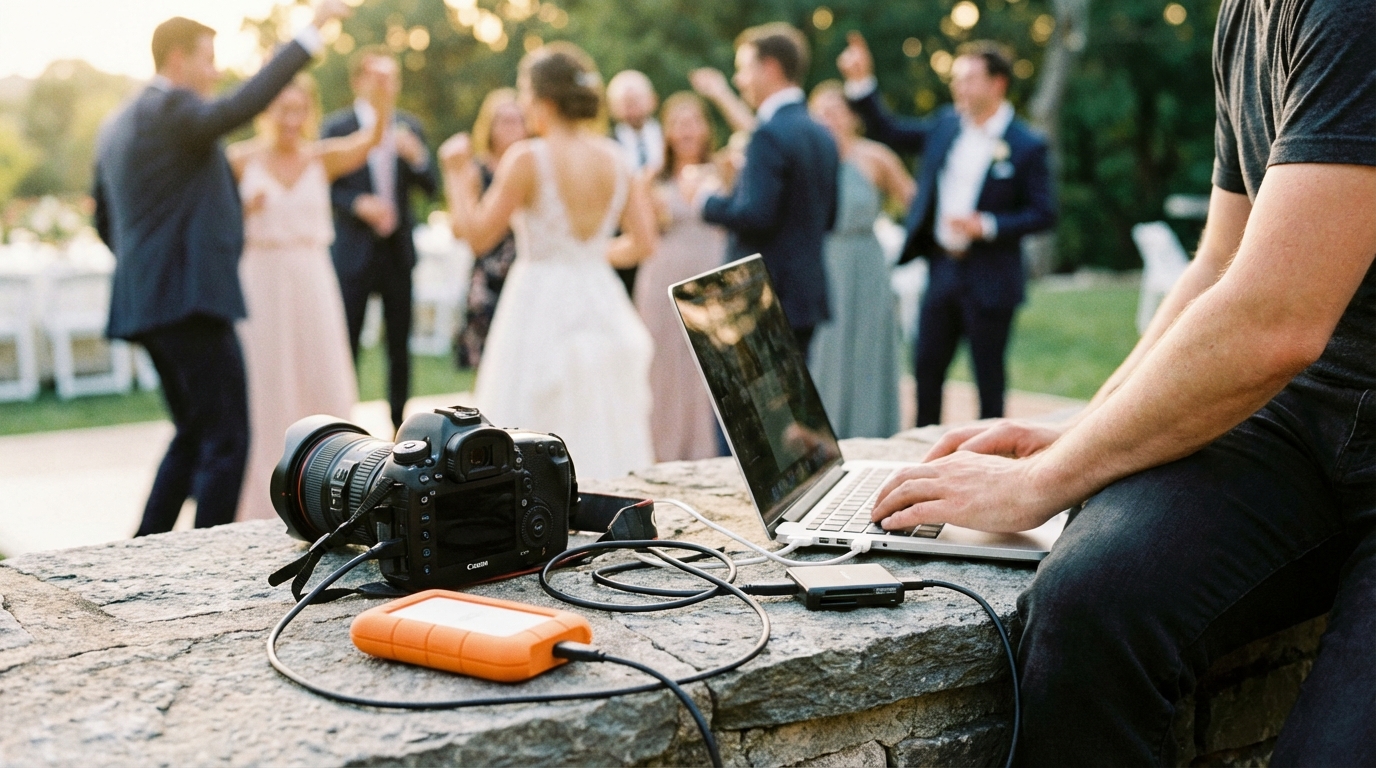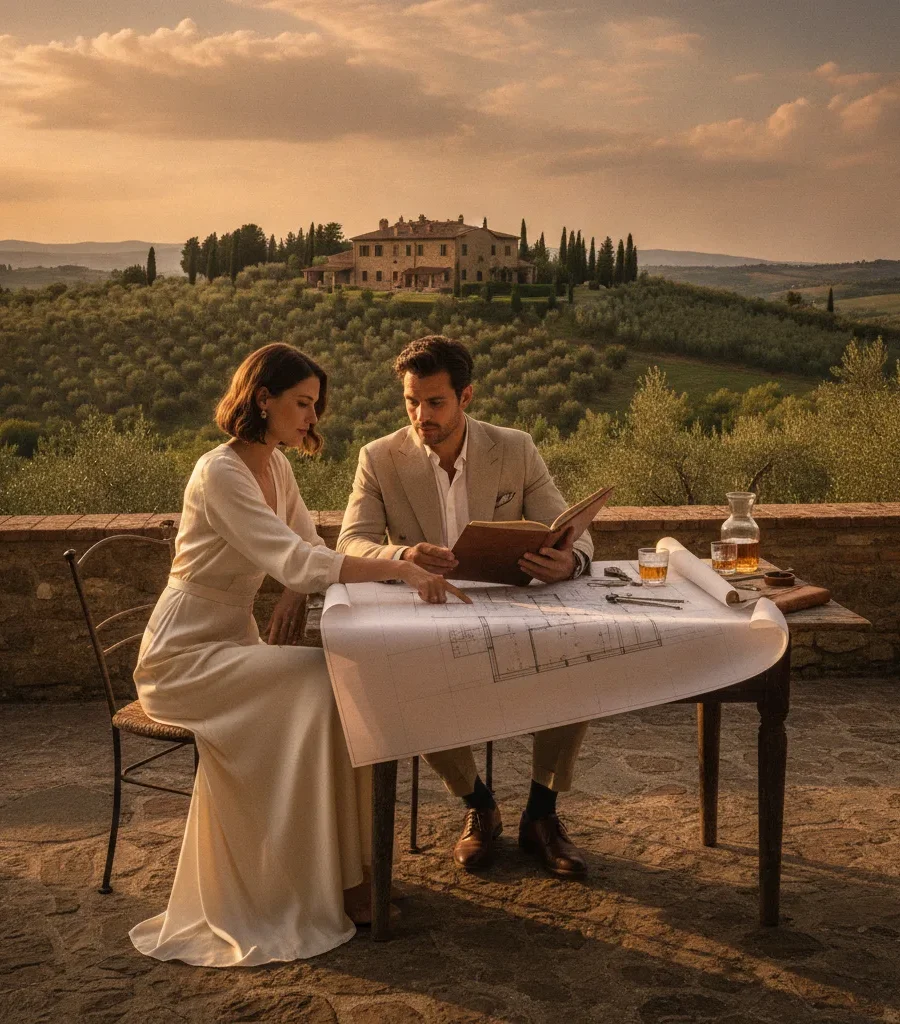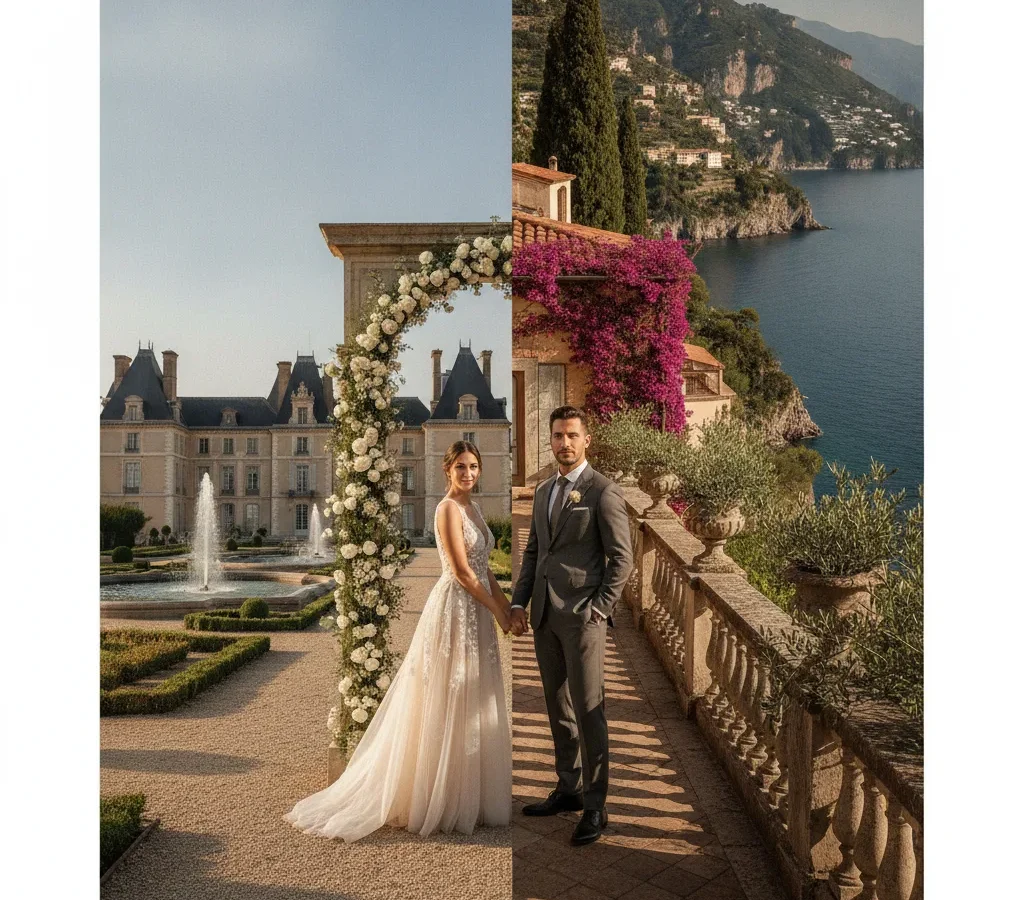
Choosing between France and Italy for a destination wedding is one of the first and most consequential decisions you will make, because it shapes everything that follows, from the architecture in your portraits to the paperwork on your desk.
Both countries deliver extraordinary celebrations, yet they do not deliver the same experience. France leans toward château elegance, formal gardens and large exclusive-use estates, while Italy leans toward villas, lakes, coastlines and a warm Mediterranean colour palette. As photographers working across both territories, we see where couples thrive and where they get stuck. This comparison lays out venues, costs, legal requirements, seasons, logistics and photography, so you can decide with clarity rather than instinct alone.
Choosing Between France and Italy Destination Wedding
Reading time: ~10 min
- Choosing Between France and Italy for a Destination Wedding, the Short Answer
- France, Château Weddings and Weekend Exclusivity
- Italy, Villas, Lakes and Mediterranean Atmosphere
- France vs Italy Destination Wedding Cost Comparison
- Legal Requirements for Foreign Couples
- Which Country Is Better for Wedding Photography
- Seasons, Guests and Logistics
- Final Decision Framework
- Frequently Asked Questions
Choosing Between France and Italy for a Destination Wedding, the Short Answer
The honest answer is that neither country is objectively better. They answer different briefs. If your vision involves a private château taken over for an entire weekend, with a welcome dinner on the gravel courtyard, a rehearsal event in the orangery and a post-wedding brunch by the pool, France is usually the stronger starting point.
If you picture a villa terrace above water, cypress-lined drives, golden hour portraits over a lake and guests extending their stay into a longer Italian holiday, Italy will almost certainly feel more right. The France vs Italy wedding debate usually resolves itself once you separate three things: the visual identity you want, the legal route you intend to take, and the real total cost of the production.
| Criteria | France | Italy |
|---|---|---|
| Signature settings | Châteaux, domaines, French gardens, vineyards, Provence, Loire Valley | Tuscan villas, Lake Como, Amalfi Coast, Puglia masserie, historic palazzi |
| Venue strength | Broad supply of exclusive-use estates with on-site accommodation | Strong villa, lakeside and coastal offering with high visual impact |
| Legal complexity for foreigners | Can be restrictive for two non-resident foreign nationals | Generally a declaration of no impediment plus consular documentation |
| Indicative total cost | Around $35,000 to $80,000 depending on scale and inclusions | Around $30,000 to $60,000, with premium locations rising sharply |
| Best suited to | Formal elegance, estate weddings, multi-day celebrations | Romantic scenery, villa weddings, Mediterranean guest experience |
| Photographic character | Architectural grandeur, soft countryside light, editorial interiors | Dramatic landscapes, warm tones, sunset portraits over water |
France, Château Weddings and Weekend Exclusivity
Exclusive-use château estates
France has an unusually deep supply of châteaux, domaines and vineyard estates marketed specifically for exclusive-use weddings, which is why a château wedding in France so often becomes a full weekend rather than a single day. Many properties in the Loire Valley, Provence, Normandy and the southwest include on-site accommodation and extensive grounds, which makes a multi-day celebration logistically coherent. Guests arrive once, settle in, and the weekend unfolds in a single, controlled environment. That matters enormously for visual consistency, because every event shares the same architecture, light and material palette.
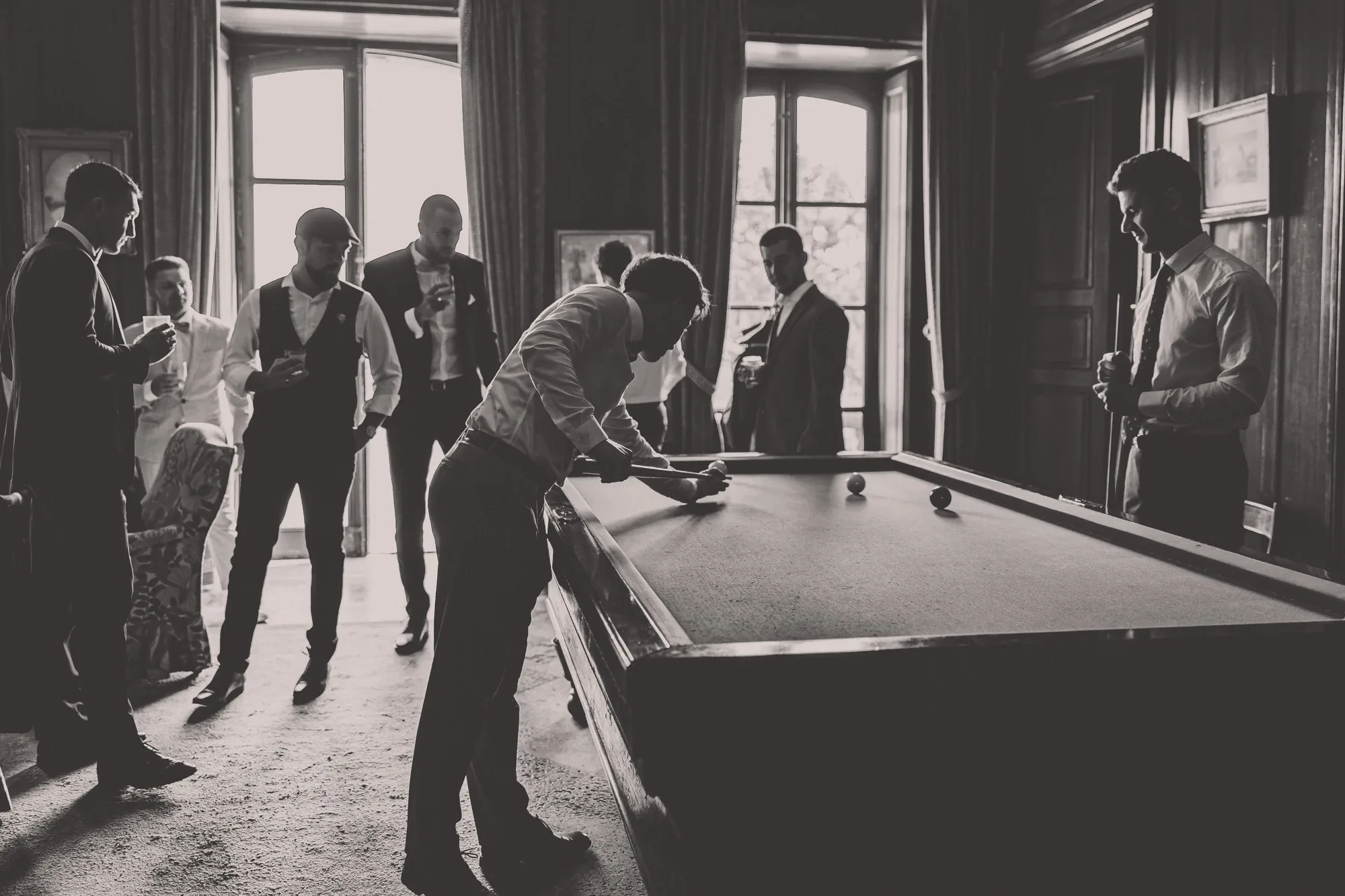
For photography, France offers formal façades, gravel courtyards, fountains, long garden perspectives, vineyards and lavender fields, plus historic interiors that read beautifully in editorial wedding photography. Our own portfolio includes château celebrations in the Loire-adjacent countryside and alpine estates near Annecy and Menthon-Saint-Bernard, where the shift from lake to mountain to historic interior happens within minutes.
The practical trade-offs in France are real, though. Rural estates often require transfers and shuttles, noise curfew restrictions can shorten the party, and seasonal availability at the most desirable properties disappears well over a year ahead.
Italy, Villas, Lakes and Mediterranean Atmosphere
Italian villa and lakeside settings
Italy is the natural home of the villa wedding. A Tuscany destination wedding built around a stone estate, olive groves and a long outdoor dinner has a different emotional register to a French château: more sun, more informality, more drama in the landscape. Lake Como and Lake Maggiore deliver terraces and water views that photograph like a film set, the Amalfi Coast adds cliffs and sea, Puglia brings whitewashed masserie, and Umbria and Sicily offer quieter alternatives at a different price point. For many American couples, an Italy destination wedding also sells itself to guests, because the surrounding region doubles as a holiday.
Italy’s destination wedding ecosystem is highly developed, particularly around Tuscany, the lakes, the Amalfi Coast and Puglia, which means deep local planning expertise and very experienced luxury event suppliers. The counterweight is logistics. Some venues sit at the end of narrow historic roads with limited parking, transfer time from the airport can be substantial, and a number of villas provide the walls and the view but nothing else, so catering buyout, furniture, lighting, staffing and generators become separate line items. Always confirm venue hire inclusions in writing before you commit.
Good to know
In Italy, many wedding services fall under 22% IVA, the Italian VAT. A quote that looks comparable to a French one can rise meaningfully once tax is applied, so ask every supplier whether their figure is gross or net.
France vs Italy Destination Wedding Cost Comparison
Typical budget ranges
For equivalent quality, the two countries land in broadly similar territory, and the differences come from inclusions rather than nationality. One European destination wedding overview places most celebrations between roughly $25,000 and $75,000 or more, with Italy estimated at around $30,000 to $60,000 and France at around $35,000 to $80,000.
A specialist France and Italy comparison reports an indicative median château weekend price of about €8,750 in France against roughly €10,000 to €15,000 for comparable Italian properties. A third planning source estimates a 40 to 60 guest wedding at approximately £18,000 to £35,000 in France and £22,000 to £42,000 in Italy. All of these figures are indicative only and shift with region, season and supplier mix.
The real discipline is comparing complete production costs rather than venue hire alone. The drivers that move the number most are venue exclusivity, catering and drinks, accommodation, planner fees, transport between airports, hotels and the venue, furniture and lighting, florals and seasonal availability, entertainment, documentation and translations, and applicable taxes. Hidden costs in Italy typically cluster around external suppliers and production infrastructure at villas that are not turnkey. Hidden costs in France usually appear as transport, extended staffing across a multi-day celebration, and heating or marquee contingency outside peak summer.
Legal Requirements for Foreign Couples
This is where the two countries genuinely diverge, and where early verification saves months of stress. In France, civil marriage is conducted through the municipality and the marriage file must be submitted to the relevant town hall. For two foreign nationals who do not live in France, the French public service guidance indicates that legal marriage options may be limited to specific jurisdictions, including a consulate of their country of origin, subject to eligibility. In practice, a legal wedding in France for foreigners with no residency link is often not straightforward, which is why most of our American couples complete the civil formalities at home and hold a symbolic ceremony abroad.
Italy tends to be more accessible administratively. Foreign nationals generally need a declaration of no impediment issued by the competent authority in their home country, submitted to the Italian municipality where the marriage will take place, as set out in guidance from the Italian Ministry of Justice and Italian consular services. The civil ceremony is normally performed publicly by the civil registrar at the town hall, although certain licensed venues may be authorised to host legally valid ceremonies. Americans marrying in Italy should expect consular documentation, translations and legalisation, and should build the paperwork timeline into their planning calendar rather than treating it as an afterthought.
Important
Rules and local practice change, and eligibility depends on nationality and residency. Confirm your route directly with the relevant town hall, consulate or embassy, and with your planner, before you sign a venue contract.
Which Country Is Better for Wedding Photography
Both are exceptional, but they produce different books. France rewards couples who want architectural portraits, formal garden compositions, fashion-inspired framing and the restrained, cinematic quality of soft countryside light. A Provence wedding photographer works with stone, shutters, dry heat and long evenings. Italy rewards couples who want landscape drama, warm Mediterranean tones and golden hour portraits over water, which is why a Lake Como wedding photographer plans the entire portrait window around the last ninety minutes of light.
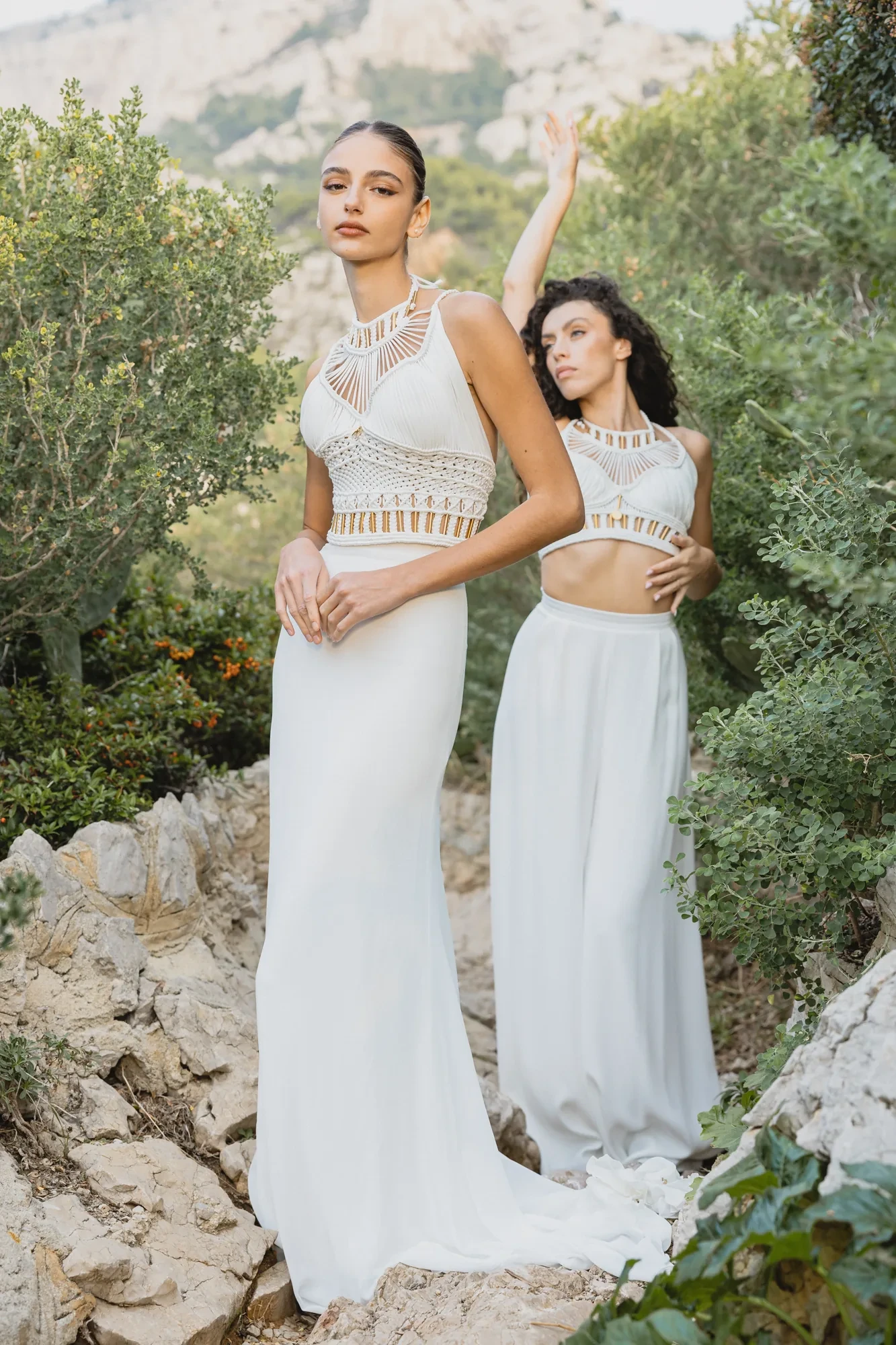
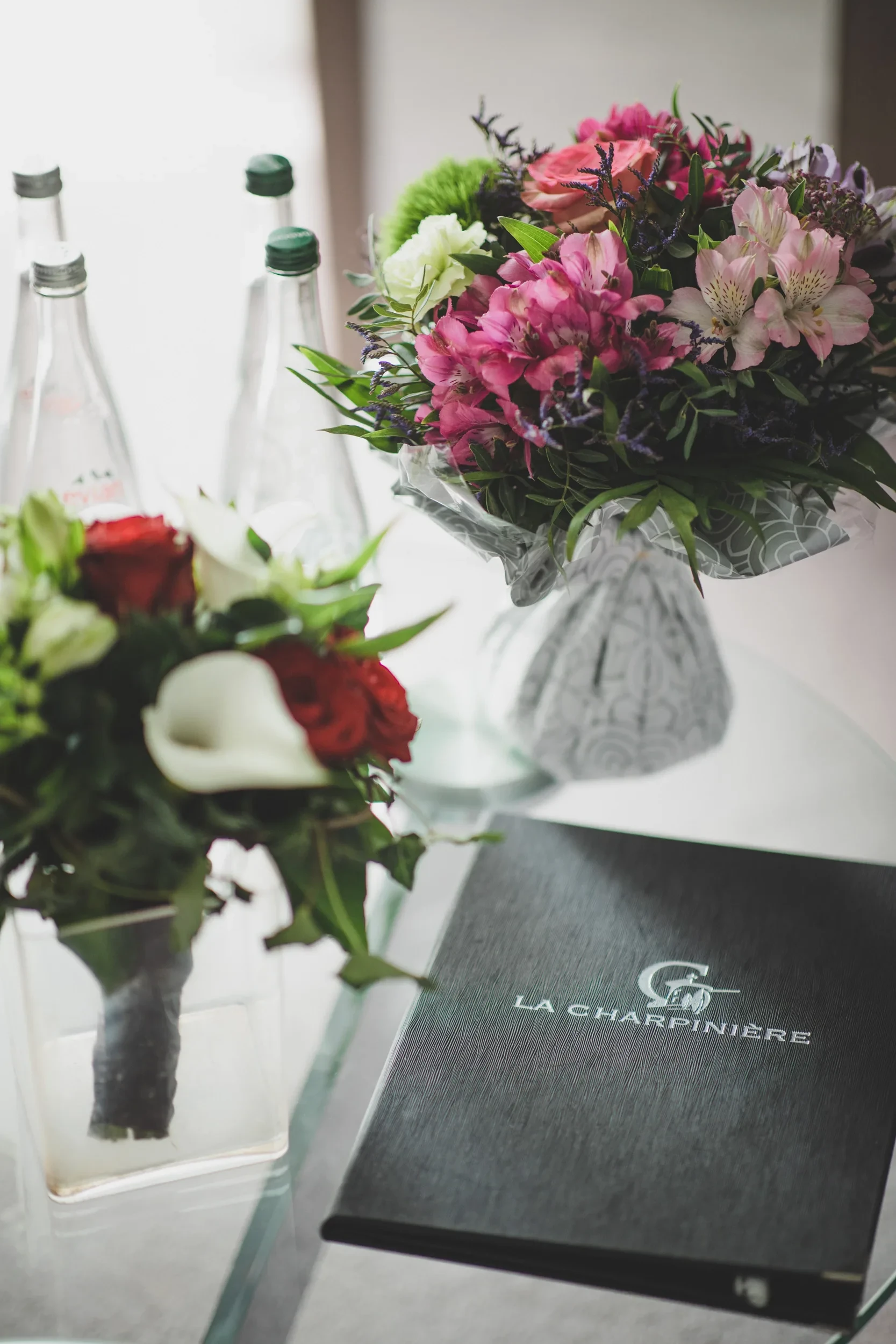
In practice, the design details decide the final gallery as much as the geography. Tablescapes, floral installations, ceremony structures such as a timber arch dressed with seasonal blooms, and the texture of a bride’s gown against a gilded mirror all need deliberate coverage, and that is a timeline question as much as an artistic one. We plan light first, then design, then people, across welcome dinner, rehearsal event, wedding day and post-wedding brunch, so the weekend reads as one visual story. You can discuss approach and coverage with us directly.
Seasons, Guests and Logistics
Late spring and early autumn are the strongest windows in both countries, with mild temperatures, blooming or harvest landscapes and manageable heat. Midsummer gives long evenings and reliable weather in the south, but Provence, the Amalfi Coast and Puglia can be punishing at midday, and the best properties book out earliest. Northern and western France carry more rainfall risk, while lake and mountain regions in Italy behave differently to Tuscany or Rome. Build the timeline around available light rather than tradition, and schedule portraits late in the afternoon when it is hot.
Before you choose, pressure-test the guest experience with a short checklist that planners use routinely.
- Nearest international airport and realistic transfer time to the venue, including traffic and narrow roads
- Availability of on-site accommodation and nearby hotels at the right standard
- Shuttle and taxi capacity for late-night departures
- Accessibility for elderly guests and anyone with reduced mobility
- Noise curfew restrictions and the real end time of the reception
- What the venue genuinely includes versus what you must bring in
Final Decision Framework
Choose France if you want a private estate, château architecture, formal gardens and a weekend that lives in one place. Choose Italy if you want villa terraces, lakes, coastlines, Tuscan hills and a guest experience that flows into a longer trip. If legal certainty is your priority, Italy’s declaration of no impediment route is often the clearer path for foreign couples, while a symbolic ceremony abroad after a civil wedding at home removes the question entirely.
Our advice to couples and to the US planners we work with is consistent: decide the visual identity first, verify the legal route second, and build the budget on total production cost rather than venue hire. Once those three are aligned, the destination stops being a dilemma and becomes the foundation of the story we photograph.
Frequently Asked Questions
Can we hold a symbolic ceremony in France and marry legally in the United States?
Yes, and it is the most common route for our American clients. You complete the civil marriage at home, then your celebrant or officiant leads a symbolic ceremony at the château or estate, with no restriction on readings, vows or location on the property.
How far in advance should we book a château or villa?
For peak season dates, twelve to eighteen months is realistic for the most sought-after exclusive-use estates, and longer if you need a specific weekend or a large on-site accommodation capacity. Photographers and planners of a certain caliber book on a similar horizon.
Do you travel between France and Italy for the same clients?
Yes. We regularly cover engagement or editorial sessions in one country and the wedding weekend in another, which is useful when a couple wants Tuscan light for portraits and a French château for the celebration itself.
Who handles the marriage paperwork, the planner or the couple?
The couple remains responsible for its own documents, but an experienced planner will map the sequence, liaise with the town hall or civil registrar, and arrange certified translations. Confirm who owns each step at the contract stage.
Is a second photographer necessary for a multi-day celebration?
For weekends above roughly one hundred guests, or when ceremony and reception design must be documented simultaneously, a second shooter protects both coverage and the design details that planners need for press submissions. We advise case by case during planning, alongside our wedding videographer coverage where relevant.
What happens if the weather turns?
Every timeline we build includes a wet-weather and extreme-heat alternative, agreed with the planner in advance, covering ceremony relocation, portrait locations indoors and adjusted lighting. The decision point is set hours ahead, not minutes.