A civil ceremony at a French mairie is far more than an administrative formality. For US couples planning a destination wedding in France, it is often the first truly French moment of their celebration and the place where all those civil ceremony mairie France tips become real: intimate, charged with emotion, and steeped in the kind of quiet elegance that only centuries-old institutions can provide.
Yet without the right preparation, this brief and structured event can slip by undocumented, or worse, be photographed under conditions that no one anticipated. Understanding how civil ceremony mairie France tips apply in practice, from booking logistics to photography permissions, is what separates a beautifully covered event from a missed opportunity. This guide walks you through everything you need to know as a couple or as a professional photographer preparing for a French town hall wedding.
Civil Ceremony Mairie France Tips for US Couples
Reading time: ~12 min
- Understanding the French civil ceremony at the mairie
- Civil ceremony mairie France tips on booking and timing
- Photography rules and permissions inside French mairies
- Photographer preparation: scouting, gear, and camera settings
- Building your town hall wedding photography timeline
- Local tips for Paris mairies by arrondissement
- Communication checklist for couples and photographers
- Bringing your mairie ceremony coverage together
- Frequently asked questions
Understanding the French civil ceremony at the mairie
Legal context of the French civil ceremony
In France, only a civil ceremony celebrated at a mairie carries legal weight. Religious or symbolic ceremonies, however beautiful, do not constitute a legal marriage on their own. This means that for any couple wishing to marry on French soil, a visit to a French town hall is not optional.
The ceremony must take place at the mairie of the commune or arrondissement where at least one of the future spouses has had domicile or residence for at least one month before the publication of the banns. This residency requirement is a practical constraint that US couples planning a destination wedding in France need to address early, often in coordination with their wedding planner. The publication of banns, a public announcement of the intended marriage, is a mandatory step in the French process and must precede the ceremony by at least ten days.
The ceremony itself is celebrated in a public room of the town hall, the salle des mariages, which is open to the public. This means that any member of the public may, in theory, enter during the ceremony. In practice, the room is typically filled with invited guests, but the open-access nature of the space has direct implications for photographers: the room is rarely designed for large gatherings, and movement must be considered carefully.
The required documents typically include:
- Valid identification for both spouses
- Recent birth certificates
- A recent proof of address
- A duly completed and signed application form
Some situations, particularly for foreign nationals, may require additional paperwork such as sworn translations or consular acts, which can generate costs. The ceremony itself, however, is free of charge. This is worth noting for couples who are allocating their budget: the mairie costs nothing, which means the investment can flow entirely toward photography, portraits, and the broader visual documentation of the day.
Civil ceremony mairie France tips on booking and timing
Booking your mairie date and ideal time
One of the most common mistakes US couples make when planning a French civil wedding is underestimating how early they need to act. Depending on the commune, mairies open their booking calendar three to six months in advance, and some popular town halls in Paris or the French Riviera may open bookings up to a year ahead. Contacting the mairie as soon as a date is in mind is essential, both to secure the slot and to begin gathering information about the specific rules of that particular town hall.
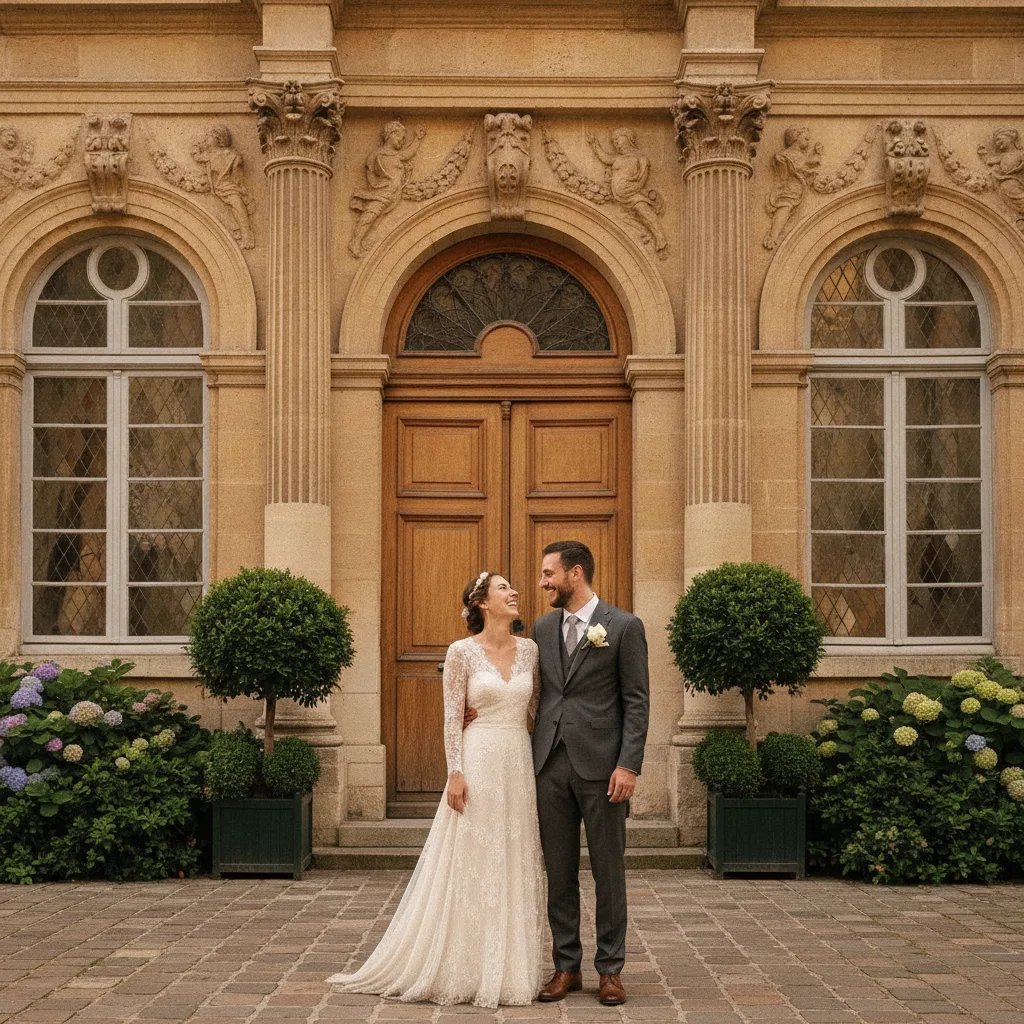
When it comes to the time of day, late morning or early afternoon tends to offer the most flattering natural light for photography. Early morning slots, while sometimes available, can produce harsh directional light or heavy shadows depending on the orientation of the building and the season. Scheduling the civil ceremony between 10:30 and 13:00 generally gives photographers the most workable conditions indoors and outdoors.
For couples planning their full day around the mairie, a realistic time allocation in Paris, covering the ceremony itself, family group shots, and a couple portrait session nearby, is approximately two hours when all locations are within walking distance of each other. Couples are advised to arrive fifteen to twenty minutes before the official start time. Photographers should plan to be on location at least thirty to forty-five minutes before the ceremony begins, allowing time for a wide-angle establishing shot of the building, a quick assessment of interior light conditions, and any last-minute adjustments to settings.
Photography rules and permissions inside French mairies
This is the area where many photographers and couples are caught off guard. There is no national standard governing photography inside French mairies during civil ceremonies. The decision rests entirely with the officiant du mariage, typically the mayor or a deputy mayor, and policies can vary dramatically from one arrondissement to the next, or even from one ceremony to another within the same town hall.
In some mairies, professional photographers are welcomed and can move freely within the room. In others, photography is restricted to family members using their phones. In a small number of cases, cameras are prohibited entirely during the ceremony. According to French Wedding Style, one of the leading expert publications on destination weddings in France, couples must confirm the photography policy explicitly when booking their date, and must pass this information on to their photographer before the day.
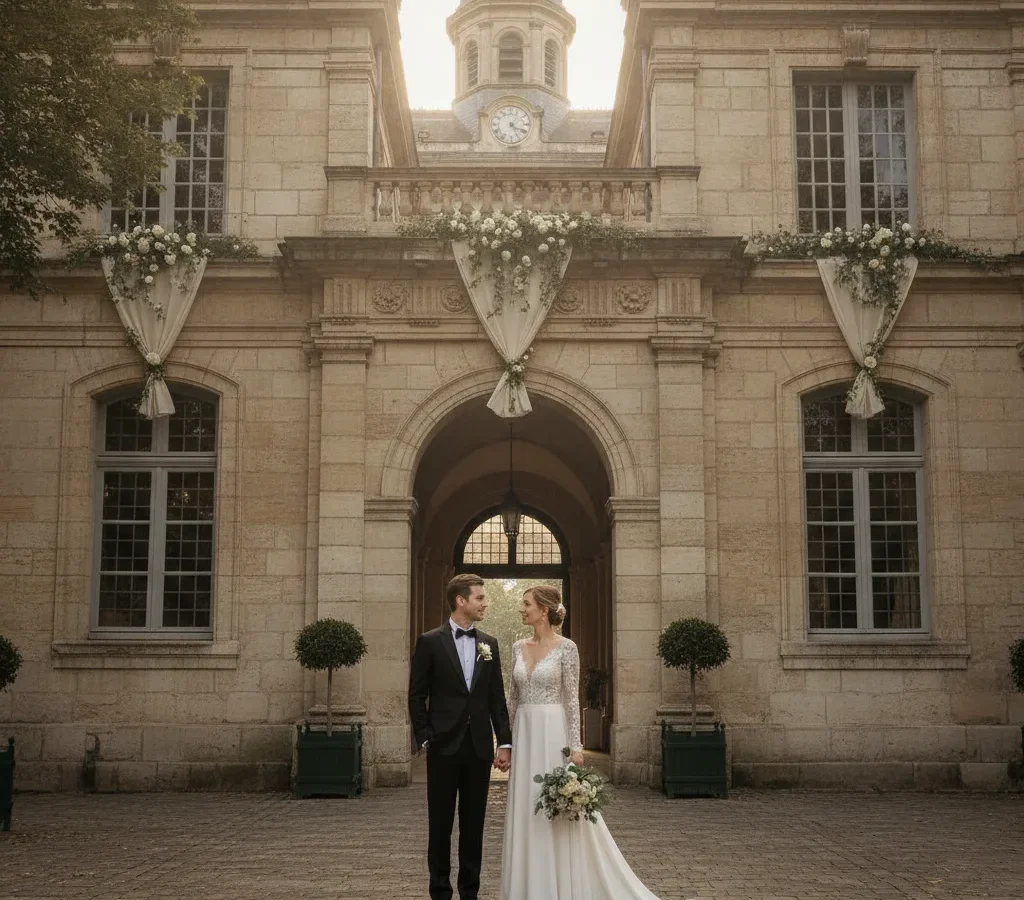
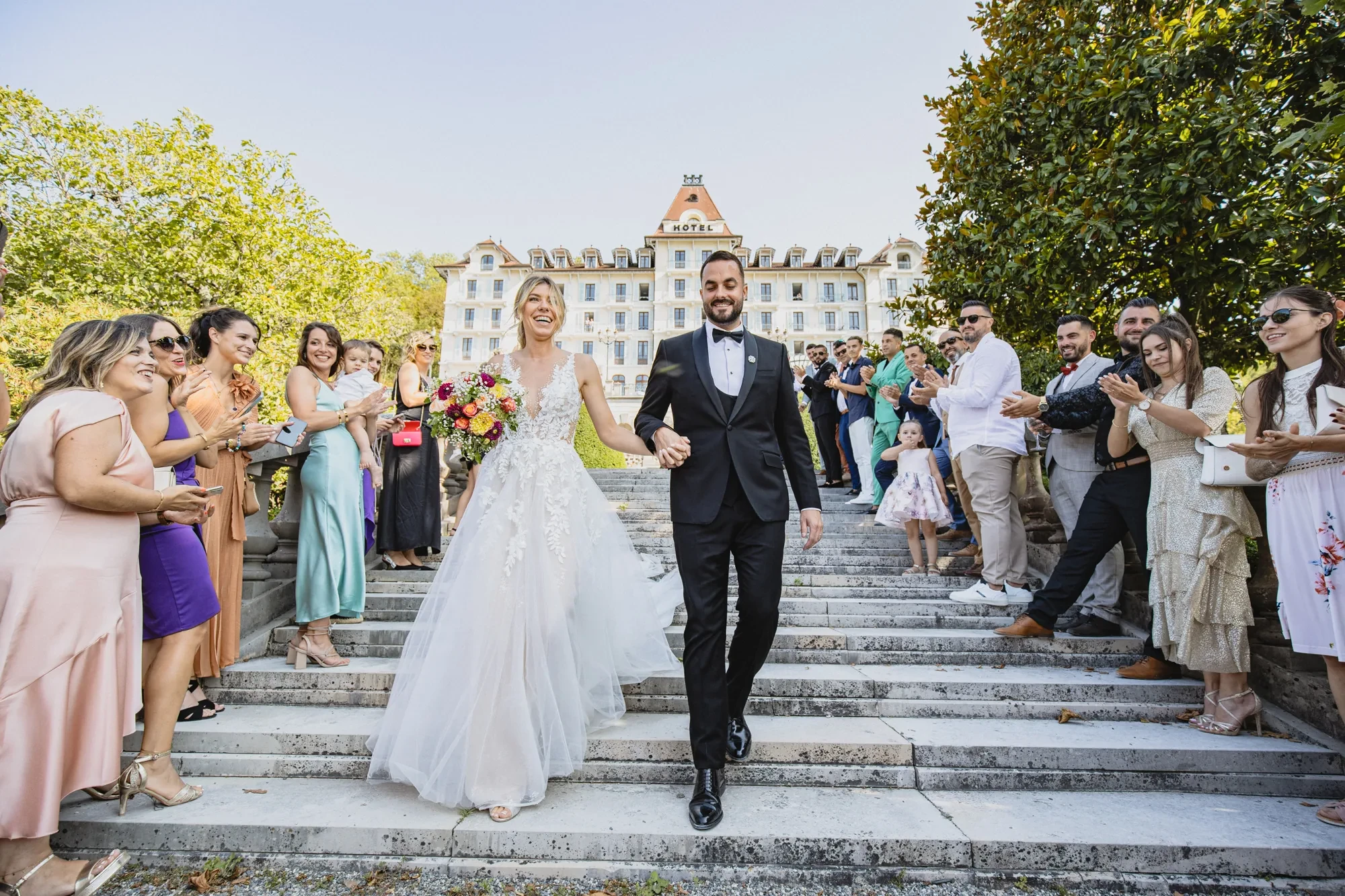
The good news is that the steps and courtyard of the mairie are always available for photographs after the ceremony, regardless of what is permitted inside. This outdoor space, often architecturally rich and filled with natural light, is where many of the most joyful and spontaneous images are made: confetti, embraces, laughter, the first moments as a married couple surrounded by guests who flew across the world to be there.
Important
Always ask your mairie two specific questions when booking: whether a professional photographer is permitted inside the salle des mariages, and whether flash photography is allowed. Note the answer in writing and share it with your photographer immediately.
Photographer preparation: scouting, gear, and camera settings
Scouting the mairie and preparing your gear
For a photographer covering a French civil wedding, preparation is not a luxury, it is a professional requirement. Visiting the mairie in advance to study the light, the layout, and the possible angles is one of the most effective ways to ensure the coverage meets the couple’s expectations. Interior spaces in historic town halls are often beautiful but challenging: high ceilings, mixed light sources, limited space for movement, and unpredictable natural light depending on the time of year.
A complete equipment check before the day is non-negotiable. Batteries should be fully charged with spares in the bag, memory cards formatted and tested, and a backup camera body available if possible. For indoor coverage in a low-light setting, fast prime lenses are the most reliable choice. A 35mm or 50mm f/1.4 or f/1.8 offers the combination of sharpness, speed, and discretion that a documentary-style approach demands in a tight space.
On camera settings, the reciprocal rule for shutter speed is a practical baseline: the exposure time should be no longer than the reciprocal of the focal length to avoid motion blur. Shooting with a 50mm lens means keeping the shutter at 1/50s or faster; an 85mm lens calls for at least 1/85s, ideally 1/100s or above. Many photographers working in French mairies choose to shoot without flash entirely, relying on natural light and high ISO performance for a more authentic, unobtrusive result. At the mairie of the 15th arrondissement in Paris, for instance, experienced photographers have noted that the room’s natural light is sufficient for clean, natural portraits without any artificial fill.
The following table summarises the key technical parameters for indoor mairie ceremony coverage.
| Parameter | Recommended approach | Notes |
|---|---|---|
| Shutter speed | At least 1/focal length (e.g. 1/50s for 50mm) | Increase if subjects are moving |
| Aperture | f/1.4 to f/2.8 | Fast prime lenses preferred |
| ISO | 800 to 3200 depending on light | Test on arrival; adjust per room |
| Flash | Avoid if possible | Confirm with officiant; natural light preferred |
| Lens choice | 35mm, 50mm, or 85mm prime | Versatile in tight spaces |
| Arrival time | 30 to 45 minutes before ceremony | Allows scouting and test shots |
Building your town hall wedding photography timeline
A well-structured timeline is the backbone of strong civil ceremony coverage. Without one, even the most talented photographer can find themselves reacting rather than anticipating, and key moments slip by. The timeline should be built in three phases: before the ceremony, during, and after.
Before the ceremony, the photographer should use the first thirty to forty-five minutes on location to capture the building itself, the arrival of guests, candid moments of anticipation, and any decorative details present. If the couple has arranged a portrait session before the ceremony, this is the time to execute it. At the mairie of the 15th arrondissement in Paris, a particularly effective approach involves beginning with forty-five minutes of couple portraits at Square Saint-Lambert while guests make their way to the town hall, followed by fifteen minutes of lifestyle images at a nearby café terrace before the official start.
During the ceremony, the priority is discreet documentary coverage. The photographer should move quietly along the edges of the room, focusing on the exchange of vows, the signing of the civil register, the reactions of parents and close friends, and the small, unrepeatable glances between the couple. This is not the moment for direction or posing. It is the moment to observe and to feel the room.
After the ceremony, the steps and courtyard of the mairie become the natural stage for the first celebrations: confetti, embraces, group photographs, and the energy of a crowd releasing weeks of anticipation. Couples should plan for twenty to thirty minutes of photography immediately after the ceremony, either on the mairie steps or in the surrounding streets and parks. At the mairie of the 19th arrondissement in Paris, the morning light on the façade is notably soft and well-suited to elegant, natural portraits in the immediate aftermath of the ceremony.
Bon à savoir
When planning group photographs, a simple list of six to eight family groupings, beginning with grandparents and young children, helps the photographer move efficiently and ensures no key combination is missed before guests begin to drift away.
Local tips for Paris mairies by arrondissement
Paris is home to twenty arrondissements, each with its own mairie, its own architectural character, and its own photographic possibilities. No two are identical, and the experience of photographing a civil ceremony at the mairie of the 8th arrondissement near the Champs-Elysées will be entirely different from one in the 20th or the 15th.
For the 15th arrondissement, Square Saint-Lambert is the go-to location for couple portraits before or after the ceremony. The square is close enough to walk to, offers varied backgrounds including mature trees, benches, and soft filtered light, and is rarely crowded during a weekday morning ceremony. The café terrace opposite the mairie provides a relaxed, Parisian lifestyle setting that translates beautifully into editorial-style images.
For the 19th arrondissement, the streets immediately surrounding the mairie offer a rich urban texture that works well for a more documentary, atmospheric style of photography. The morning light on the building’s façade is particularly clean and diffused, making it ideal for portraits that feel natural rather than posed. Planning twenty to thirty minutes of street-level photography after the ceremony allows the photographer to capture the couple in genuine movement and interaction, surrounded by the neighbourhood that hosted their legal union.
For couples marrying outside Paris, whether in Provence, Savoie, or along the French Riviera, the same principles apply: scout the location in advance, confirm photography permissions directly with the mairie, identify a nearby outdoor space for portraits, and plan a backup in case of rain. You can explore examples of how this approach translates across different French regions in the portfolio.
Communication checklist for couples and photographers
Clear communication between a couple and their photographer before a French civil ceremony is what makes the difference between a gallery that captures the full emotional arc of the day and one that documents only its surface. The following checklist covers the essential information that should be exchanged well in advance of the wedding day.
Couples should share with their photographer:
- The exact address of the mairie and the official ceremony time
- The call time that the mairie has asked them to arrive
- The name and phone number of a contact person reachable on the day
- The photography policy confirmed with the mairie
- A list of six to eight key family groupings for group shots
- Any mobility constraints or elderly guests who should be prioritised during group photography
- The chosen location for couple portraits after the ceremony along with a backup plan in case of poor weather
Photographers, in turn, should confirm with the couple whether a pre-ceremony portrait session is planned and where, the expected duration of the ceremony, any specific moments the couple wants prioritised, and the delivery expectations for sneak peeks if the images are needed quickly for social media or press submissions. For US couples working with a European-based photographer, this exchange typically happens over a video call in the weeks leading up to the wedding. The goal is to arrive on the day with no open questions, only the freedom to observe, create, and document.
Bringing your mairie ceremony coverage together
A French civil ceremony at the mairie is brief by design, rarely lasting more than twenty to thirty minutes, but its emotional weight is entirely disproportionate to its duration. For US couples investing in a destination wedding in France, it deserves the same level of photographic attention as the reception, the floral installations, or the grand venue itself.
With the right preparation, the right photographer, and a clear understanding of how civil ceremony mairie France tips apply in practice, this quiet legal moment can become one of the most moving images in the entire wedding gallery. If you are beginning to plan your French destination wedding and would like to discuss how this coverage can be integrated into a full multi-day photographic experience, you are welcome to reach out through our contact page or explore the full portfolio.
FAQ
Is it possible to have both a civil ceremony in France and a religious or symbolic ceremony on the same day?
Yes, many couples in France choose to hold their civil ceremony at the mairie in the morning and a religious or symbolic ceremony later in the day at their venue. The two events can be photographed as part of a single continuous coverage, provided the timeline is planned carefully with sufficient travel time between locations.
Can a French civil ceremony take place at a private venue rather than the town hall?
In exceptional circumstances, a mayor may agree to celebrate a civil marriage outside the mairie, for instance at a hospital for medical reasons. For standard destination weddings, however, the ceremony must take place in the public room of the relevant town hall. There is no provision for holding a legally binding civil ceremony at a private chateau or villa.
Do US couples need a French address to marry at a French mairie?
At least one of the two future spouses must have had domicile or residence in the relevant commune for at least one month before the publication of the banns. In practice, some couples establish a temporary residence in France for this purpose, a step that requires planning well in advance and is best handled with the support of a local wedding planner familiar with French administrative requirements.
How long does it take to receive the official marriage certificate after a French civil ceremony?
The acte de mariage, the official French marriage certificate, is typically issued by the mairie shortly after the ceremony. However, obtaining certified copies for use in the United States, including any apostille required for legal recognition, can take additional weeks. Couples should factor this into their post-wedding administrative timeline.
What happens if the mairie prohibits photography inside the ceremony room entirely?
Even in the most restrictive cases, the exterior of the mairie, its steps, courtyard, and surrounding streets, remains fully available for photography. A skilled photographer will use the time before and after the ceremony to create a complete visual narrative of the day, ensuring that the absence of indoor coverage does not diminish the quality or the emotional depth of the final gallery.